
Behringer X AIR XR18
4.6Editor score
18 Channel Inputs
MIDAS Preamps
WiFi Control
This comprehensive guide compares the top ten digital mixing consoles available in October 2026 to help you choose the right board for your audio needs.
Digital mixing consoles have revolutionized the way professionals manage audio in live sound and studio environments. These advanced systems offer unprecedented control over signal processing, routing, and effects allowing engineers to craft pristine mixes with greater efficiency than ever before.
To create this list we evaluated ten leading digital mixing consoles based on their input capabilities preamp quality build durability and feature sets. We considered factors such as channel counts bus architectures connectivity options and user interface design to ensure a balanced comparison for various use cases.
Each product in our roundup highlights specific strengths whether you need a compact solution for small venues or a robust system for large scale productions. Please note that pricing and availability fluctuate frequently so verify current details on the product pages before making your final purchasing decision.
4.6Editor score

4.7Editor score

4.5Editor score
The following comparison table outlines the key specifications and features of each digital mixing console featured in this guide to help you quickly identify the model that best fits your technical requirements.




The Behringer X32 stands out as the top choice for professional audio engineers seeking a powerful yet affordable digital mixing solution. With a rating of 4.7 stars it has earned trust among users for its reliability and sonic performance in both live and studio settings.
We may earn a commission when you buy through this link, at no additional cost to you.
This console features 32 MIDAS-designed mic preamps that deliver audiophile quality sound across its 40 input channels. The 25 fully automated motorized faders provide instant visual overview and precise control over scenes allowing for seamless transitions during complex productions.
While the sheer number of features can be daunting for new users the learning curve is justified by the depth of control offered. The large footprint requires dedicated space but ensures physical access to critical controls during high-pressure mixing situations.
Engineers looking for a comprehensive mixing solution that balances high-end audio processing with cost-effectiveness will find the X32 to be an ideal investment for their professional toolkit.
The 32 MIDAS-designed preamps ensure clean signal capture with minimal noise even at high gain settings.
Motorized faders allow for instant recall of scenes saving time during live event setups.
We may earn a commission when you buy through this link, at no additional cost to you.
The Allen & Heath Qu-5 represents the pinnacle of digital mixing technology with its 96kHz XCVI FPGA processing engine. This system delivers exceptional audio quality and ultra-low latency making it perfect for professional live sound and installed audio applications.
We may earn a commission when you buy through this link, at no additional cost to you.
Its flexible architecture supports up to 38 inputs and 12 configurable mixes offering immense versatility for varied production environments. The 7-inch capacitive touchscreen combined with 17 motorized faders provides an intuitive workflow that simplifies complex mixing tasks.
Although the initial cost is higher than many competitors the investment pays off through superior performance and future-proof connectivity options. Users may need time to master the extensive features but the efficiency gains are significant for seasoned professionals.
For those demanding the highest audio fidelity and advanced control features the Qu-5 is a top-tier choice that elevates the entire mixing experience.
The FPGA engine ensures precise audio handling with minimal latency for real-time mixing.
Includes USB-C multichannel interface and SLink expansion for extensive I/O capabilities.
We may earn a commission when you buy through this link, at no additional cost to you.
The Behringer X AIR XR18 offers an accessible entry point into digital mixing with its affordable price and powerful feature set. Rated at 4.6 stars it appeals to small venue operators and home studios needing professional sound without a large footprint.
We may earn a commission when you buy through this link, at no additional cost to you.
Control is handled via a built-in Tri-mode Wi-Fi router allowing operation from any iPad or Android tablet. The 16 programmable MIDAS preamps ensure high-quality audio capture while the compact design saves valuable rack space in tight setups.
The lack of physical faders may be a drawback for those who prefer tactile control but the tablet interface offers flexibility and remote access. Users relying heavily on tablets should ensure device stability for consistent performance during critical sessions.
For budget-conscious buyers requiring reliable audio quality and modern connectivity the XR18 is an outstanding value proposition in the digital mixer market.
The integrated Wi-Fi module enables direct control without needing external routers or cables.
MIDAS-designed preamps deliver clean gain and low noise floor for professional audio.
We may earn a commission when you buy through this link, at no additional cost to you.
The Yamaha DM3 Standard brings legendary Yamaha sound quality to a highly portable form factor ideal for touring or small installations. Its 4.4 rating reflects user satisfaction with its intuitive design and robust audio performance in varied environments.
We may earn a commission when you buy through this link, at no additional cost to you.
Featuring 22 channels and a best-in-class 9-inch touchscreen the DM3 simplifies complex mixing tasks without overwhelming the operator. The 96kHz sample rate ensures high-fidelity audio capture making it suitable for recording applications alongside live mixing.
While the limited channel count may not suit large productions the compact size and easy setup make it perfect for smaller venues or broadcast use. Users accustomed to analog consoles may find the touchscreen navigation slightly different but highly efficient once learned.
Touring sound engineers and broadcasters seeking a lightweight reliable mixer will appreciate the DM3s balance of portability and professional features.
The ultracompact form factor allows easy transport and setup in tight venues.
96kHz sample rate ensures crystal clear audio for both mixing and recording.
We may earn a commission when you buy through this link, at no additional cost to you.
The Behringer WING is designed for large-scale productions requiring extensive channel counts and routing flexibility. With a 4.2 rating it serves as a powerful tool for major events where audio precision and reliability are paramount.
We may earn a commission when you buy through this link, at no additional cost to you.
It features 8 award-winning Midas PRO mic preamps and 24 motorized faders split into configurable sections for efficient workflow management. The large main display with capacitive touch screen enhances control while AES50 ports ensure ultra-low latency I/O connectivity.
The sheer size and weight of the WING necessitate a dedicated setup which might limit its use for mobile applications. High cost is also a factor but justified by the professional grade components and scalability for complex audio environments.
Fixed installations and large venue engineers needing maximum routing options will find the WING to be a robust and capable solution for their demanding needs.
Onboard MIDAS PRO preamps deliver industry-leading sound quality and dynamic range.
AES50 ports provide ultra-low jitter and latency for digital I/O signals.
We may earn a commission when you buy through this link, at no additional cost to you.
The Yamaha MGX12 distinguishes itself as a multimedia mixer ideal for content creators needing audio and video integration. Its perfect 5.0 rating highlights exceptional user satisfaction with its innovative features and ease of use for hybrid workflows.
We may earn a commission when you buy through this link, at no additional cost to you.
Featuring 4K video capture and pass-through alongside a powerful USB-C audio interface this console supports seamless recording and streaming. The 4.3-inch touchscreen and tactile faders provide intuitive control over audio levels and DSP processing.
While the channel count is limited for traditional live sound it excels in podcasting and web conferencing scenarios. The included software bundle adds value by providing essential DAW tools for immediate professional-grade production capabilities.
Content creators and streaming professionals will find the MGX12 offers a unique blend of audio mixing and video production tools.
Built-in USB-HDMI interface enables 4K video capture for synchronized multimedia projects.
Includes Cubase Al and other tools to streamline production workflows immediately.
We may earn a commission when you buy through this link, at no additional cost to you.
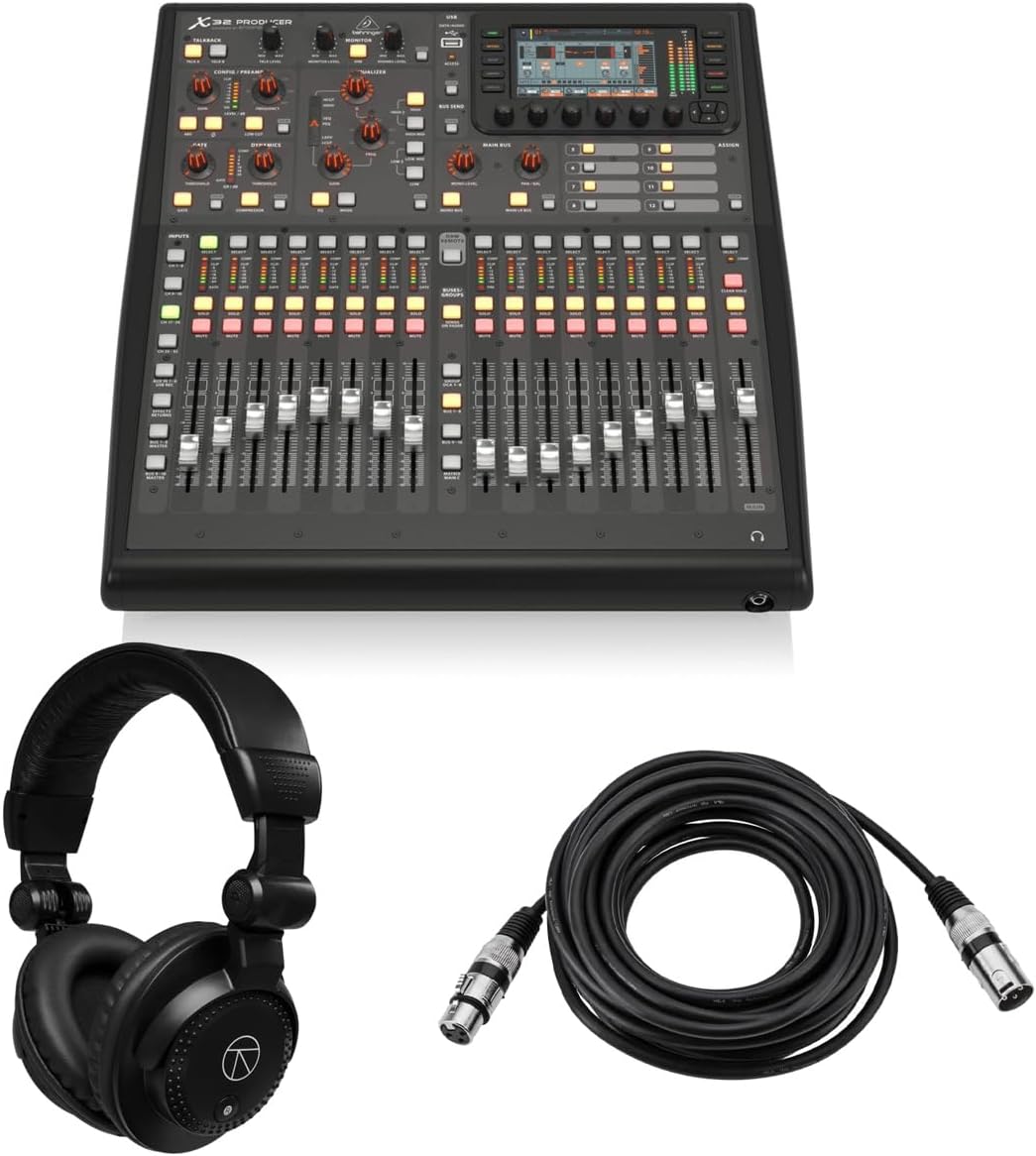
The Behringer X32 PRODUCER delivers full-scale digital mixing power in a rack-mountable format ideal for fixed installations. A perfect 5.0 rating reflects its success in delivering reliable professional performance for studio and live applications.
We may earn a commission when you buy through this link, at no additional cost to you.
With 16 programmable MIDAS preamps and 40 input channels it handles complex setups effortlessly while the internal FX engines provide creative sound shaping. The bundle with headphones and cables adds immediate value making it a complete solution for new users.
The absence of physical faders on the unit itself means remote control is required but this saves valuable rack space. The robust build quality ensures consistent performance over time even in demanding environments.
Sound engineers requiring a compact yet powerful rack solution for permanent installations will find the X32 PRODUCER meets their needs perfectly.
Delivers the full functionality of the X32 series in a rack-mountable chassis.
Includes essential accessories like headphones and cables to start using immediately.
We may earn a commission when you buy through this link, at no additional cost to you.
The BEHRINGER X32 COMPACT offers the robust capabilities of the larger X32 in a more space-efficient chassis. Rated at 4.7 stars it maintains the high performance standards while reducing the physical footprint for mobile or smaller setups.
We may earn a commission when you buy through this link, at no additional cost to you.
With 16 MIDAS-designed preamps and 17 fully automated motorized faders it retains professional-grade mixing tools essential for live sound. The compact design allows easier transport and setup without sacrificing the core routing and processing features.
Some users may find the reduced output count limiting compared to the full model but it suffices for most mid-size productions. The trade-off in size is well balanced by the maintained sonic quality and control depth.
Mobile sound engineers needing reliability and portability will appreciate the balance the COMPACT provides between size and performance.
Retains full X32 capabilities in a smaller form factor for easy transport.
Automated faders ensure instant overview and precise control over the mix.
We may earn a commission when you buy through this link, at no additional cost to you.
The PreSonus StudioLive Classic offers a straightforward approach to digital mixing with its classic Fat Channel processing and solid preamps. A 3.9 rating reflects its utility for basic applications though it lacks some modern connectivity found in newer models.
We may earn a commission when you buy through this link, at no additional cost to you.
Featuring 16 Class A XMAX mic preamplifiers it ensures clean audio capture while the internal FX buses provide essential sound processing. The USB 2.0 interface supports recording and integration with computer-based workflows seamlessly.
While older technology may feel dated compared to modern touch-enabled consoles it remains reliable for users accustomed to its layout. The included software bundle adds value by enabling immediate recording and editing capabilities on a computer.
Users seeking a simple reliable mixer with robust channel strip processing will find the StudioLive Classic a dependable choice for studio or small live work.
Includes comprehensive EQ dynamics and limiting on every channel for precise tone shaping.
USB interface allows for multitrack recording directly to your computer system.
We may earn a commission when you buy through this link, at no additional cost to you.
The QSC TouchMix-16 simplifies digital mixing with an intuitive touch interface designed for ease of use. Its 4.4 rating indicates strong performance for users prioritizing simplicity and quick setup over complex routing capabilities.
We may earn a commission when you buy through this link, at no additional cost to you.
With 20 inputs and full parametric EQ on every channel it delivers professional tone shaping in a compact form. The inclusion of a carrying bag makes it highly portable for gigging musicians or small events requiring reliable audio.
The limited advanced routing may not suit complex productions but it excels in straightforward mixing scenarios. The touchscreen-only control can be a hurdle for those preferring physical knobs but ensures a clean layout.
Musicians and event organizers seeking a plug-and-play digital solution will find the TouchMix-16 provides the ease of use they require.
Full parametric EQ on all channels allows precise control over frequency response.
Comes with a durable bag for easy transport to different venues.
We may earn a commission when you buy through this link, at no additional cost to you.
Selecting the right digital mixing console involves evaluating several critical factors to ensure it meets your specific audio production needs.
Determine how many inputs and outputs you need based on your typical event size. A larger venue requires more inputs for instruments and microphones as well as more buses for monitors and effects.
Look for systems with flexible bus routing to accommodate complex setups.
Mic preamps are the heart of any mixer and directly affect sound clarity. High-end preamps like MIDAS or XMAX ensure clean gain with minimal noise.
Prioritize consoles with high-quality preamps for professional audio results.
Decide between tactile physical controls or touchscreen interfaces based on your workflow preference. Faders offer precise control while screens simplify navigation.
Choose a console that matches your comfort level with digital tools.
Modern digital mixers offer USB audio interfaces and remote control via tablets. Ensure the unit supports your recording or streaming needs.
Check for digital protocols like AES50 if you plan to expand with remote I/O.
Built-in processing like EQ compressors and reverbs reduces external gear. Look for systems with sufficient internal slots for FX.
Advanced DSP allows more complex audio shaping without external units.
Consider where the mixer will be used and how often it will be transported. Rack-mounted units save space while compact consoles fit mobile rigs.
Choose a form factor that aligns with your mobility requirements.
Think about potential growth and whether the console supports expansion via ports or software. Modular systems can adapt to changing needs.
Scalability ensures your investment remains useful as your skills grow.
Balance cost against features ensuring you get what you need without overspending. Bundles often include accessories that add value.
Invest in quality components that offer long-term reliability.
Start by connecting inputs and outputs carefully ensuring cables are secure to avoid signal dropouts during use. Calibrate gain structures early to prevent clipping and maintain headroom.
Update the mixer firmware regularly to access the latest features and stability improvements. Backup scene files and presets to external storage to prevent data loss.
Store the mixer in a dry clean environment and cover it when not in use to protect against dust. Handle the surface gently to avoid scratches on touchscreens.
Digital consoles can initially seem complex due to their feature sets but modern interfaces simplify workflows. The learning curve is shorter than many expect and digital offers advantages like recall.
Most digital mixers function independently without a computer for live sound. Computers are useful for recording or editing scenes but not strictly required for mixing.
Motorized faders allow automatic recall of mixing scenes so your settings are restored instantly. This saves time during shows and ensures consistency across multiple sessions.
Many digital mixers include built-in USB interfaces that allow direct multitrack recording. This capability is essential for capturing live performances without extra hardware.
The ideal input count depends on your venue size and band lineup. For small gigs 16 inputs suffice but large productions may need 32 or more channels.
Used digital mixers can offer great value if they are in good condition. Always test preamps and faders before purchasing to ensure they function correctly.
Regular cleaning with a soft cloth and avoiding moisture exposure helps extend the life of the mixer. Keeping firmware updated and backing up data ensures reliable operation.
Many models support remote control via tablets or smartphones over Wi-Fi. This feature allows flexible positioning during live setups.
We have explored the top digital mixing consoles available in November 2026 ranging from compact budget options to high-end professional systems. Each model offers unique strengths tailored to specific production needs and environments.
When choosing prioritize features that matter most to your workflow such as channel count and preamp quality. Consider how the console integrates with your existing setup and long-term goals.
Always verify current pricing and availability on the manufacturer or retailer websites as these details can change. Making an informed decision ensures you select the right tool for your audio projects.