
Teyleten Robot ADS1115
4.7Editor score
16-bit precision resolution
4-channel analog input
I2C interface support
This guide compares the top ten Arduino ADC boards for precision sensing, data logging, and IoT projects, evaluating resolution, channel count, and ease of
Arduino ADC boards enable microcontrollers to read analog signals with high precision. These modules convert voltage levels into digital values, making them essential for sensors like thermocouples, strain gauges, and environmental monitors.
We evaluated ten popular options based on resolution, channel count, communication interface, and build quality. Our analysis focuses on real-world performance, compatibility with common boards, and value for makers and engineers.
Each selection highlights specific strengths and trade-offs to help you choose the right tool. Prices and availability fluctuate, so check current listings before purchasing to ensure you get the best deal for your project.
4.7Editor score

4.6Editor score

4.4Editor score
This table provides a side-by-side comparison of the top ten ADC modules, highlighting key specifications like bit resolution, channel options, and interface types to help you make an informed decision quickly.


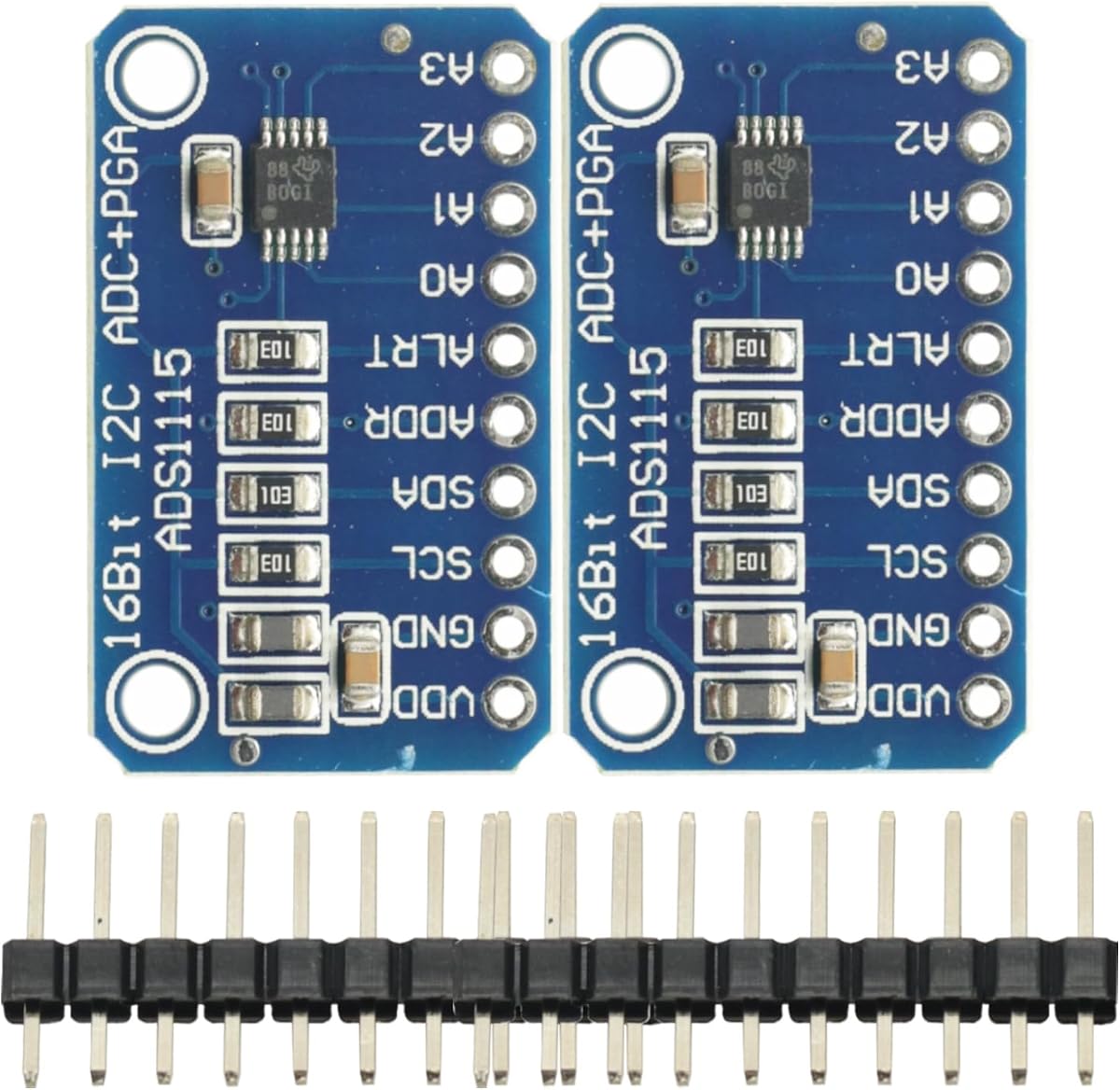


This module offers excellent value for money with three units in one pack. It provides 16-bit precision ideal for reading sensitive analog sensors without breaking the bank.
We may earn a commission when you buy through this link, at no additional cost to you.
The ADS1115 chip inside features a programmable gain amplifier allowing you to adjust input ranges from 0.256V to 6.144V. This flexibility is crucial for different sensor types like thermocouples or strain gauges.
While it lacks differential inputs on all four pins simultaneously in some modes, it still handles single-ended and differential configurations well. The I2C interface keeps wiring simple with just two data lines.
Buyers looking for a reliable entry-level ADC solution will find this kit perfect. It works seamlessly with Arduino boards and Raspberry Pi models that lack native analog pins.
The programmable gain amplifier lets you fine-tune sensitivity for low-voltage signals ensuring accurate readings across various applications.
Operating between 2.0V and 5.5V makes this module versatile for both 3.3V and 5V logic systems without needing extra shifters.
We may earn a commission when you buy through this link, at no additional cost to you.
For projects demanding extreme precision this board stands out with its 24-bit resolution. It is perfect for scientific instruments or high-fidelity data logging where tiny voltage changes matter.
We may earn a commission when you buy through this link, at no additional cost to you.
The TI ADS1256 chip ensures low nonlinearity and stable readings. The on-board ADR03 voltage source provides a reliable reference point improving overall measurement accuracy significantly.
Configuration options allow you to set inputs as single-ended or differential giving you versatility for balanced signal transmission. However, the SPI interface requires more pins than I2C options.
Engineers and hobbyists needing professional-grade performance should consider this module. It bridges the gap between hobbyist kits and industrial data acquisition systems effectively.
The integrated voltage reference ensures consistent readings by minimizing drift caused by power supply fluctuations or temperature changes.
Output rates up to 30ksps allow you to capture fast-changing signals without losing critical data points during sampling.
We may earn a commission when you buy through this link, at no additional cost to you.
This brand focuses on quality manufacturing with ENIG plating ensuring long-term durability and easy soldering. It is designed for users who value component reliability in critical projects.
We may earn a commission when you buy through this link, at no additional cost to you.
The modules are fully compatible with both 3.3V and 5V logic levels removing the need for external level shifters. This makes integration with ESP32 and Raspberry Pi straightforward.
Each pack includes three units with headers pre-soldered ready for breadboarding or permanent installation. The brand also supports open-source libraries making software setup quick and easy.
If you need components that will last in production or educational environments this option is worth the premium. It delivers consistent performance across a wide range of microcontrollers.
Electroless Nickel Immersion Gold plating resists oxidation and corrosion ensuring stable electrical connections over years of use.
Support for C++ MicroPython and CircuitPython means developers can choose their preferred language for rapid prototyping.
We may earn a commission when you buy through this link, at no additional cost to you.
This kit includes two modules with a perfect rating indicating high customer satisfaction. It offers the same core functionality as other ADS1115 boards but with a focus on simplicity.
We may earn a commission when you buy through this link, at no additional cost to you.
The programmable data rate lets you balance power consumption with sampling speed. You can configure it to run at 8sps for battery projects or 860sps for real-time monitoring.
Seven input range options provide flexibility for different signal strengths. This is especially useful when working with sensors that output very small voltage changes.
Users seeking a straightforward solution with proven reliability will appreciate this option. It is ideal for classrooms or workshops where consistency is key.
Auto shut down features help conserve battery life in portable projects by disabling the chip when not actively sampling data.
Multiple input ranges mean you can measure both small sensor outputs and larger voltage swings without changing hardware components.
We may earn a commission when you buy through this link, at no additional cost to you.
Buying three units at once provides great value for larger projects or team workshops. The modules come with essential features like programmable gain amplifiers for signal conditioning.
We may earn a commission when you buy through this link, at no additional cost to you.
Comparator mode allows you to set thresholds directly on the chip reducing load on the microcontroller. This is useful for alarm systems or trigger-based data logging.
The wide supply range ensures compatibility with most development boards. However, quality control can vary so testing each unit upon arrival is recommended.
This set is best for bulk needs where individual costs matter more than premium build quality. It gets the job done for standard analog sensing tasks reliably.
Comparator mode helps offload processing tasks by allowing the ADC to trigger interrupts based on voltage limits.
The programmable gain amplifier boosts weak signals making them easier for the microcontroller to read accurately.
We may earn a commission when you buy through this link, at no additional cost to you.
This bulk kit offers four boards for a low price making it suitable for large scale deployments. Each board includes a programmable gain amplifier to enhance signal quality.
We may earn a commission when you buy through this link, at no additional cost to you.
An internal oscillator ensures stable timing for conversions without needing external components. This simplifies the design and reduces the overall bill of materials for your project.
Support for differential inputs allows measuring signals in noisy environments effectively. Ground loops are minimized which improves accuracy for industrial sensors.
It is a practical choice for projects requiring many sensors where individual costs are a concern. Ensure you have tools to solder headers if they are not included.
Internal clocking removes the need for extra crystals making your circuit design cleaner and more compact.
Differential inputs help cancel out common-mode noise ensuring cleaner data from long cable runs or noisy industrial areas.
We may earn a commission when you buy through this link, at no additional cost to you.
These compact modules are perfect for space-constrained projects. They maintain high precision while keeping the physical footprint small for easier integration into custom enclosures.
We may earn a commission when you buy through this link, at no additional cost to you.
The voltage range allows connection to various power sources directly without regulators. This flexibility supports both modern 3.3V boards and legacy 5V systems equally.
Input range programmability gives you control over resolution versus voltage span. You can prioritize precision for small signals or range for larger ones as needed.
Ideal for users who need multiple units in a small space this set works well. Check the current price to ensure it fits your budget before ordering.
The compact design makes these modules suitable for wearable tech or embedded devices with limited internal volume.
Operating up to 5.5V means you can power them from standard USB or battery packs without extra circuitry.
We may earn a commission when you buy through this link, at no additional cost to you.
This module stands out for its simultaneous sampling capability across all eight channels. It is ideal for applications where phase alignment between signals is critical.
We may earn a commission when you buy through this link, at no additional cost to you.
The sampling frequency of 200KHz allows capturing rapidly changing waveforms. This performance level is closer to industrial standards than typical hobbyist boards.
However, integration can be challenging due to SPI requirements and specific control signals. Users should have experience with low-level protocols before attempting a build.
It is a specialized tool for high-speed data acquisition projects. If you need speed and synchronization this board offers capabilities others do not.
Simultaneous sampling ensures all channels are read at the exact same time preventing phase errors in multi-signal analysis.
With a 200KHz sampling rate you can analyze audio signals or vibration data without missing fast peaks.
We may earn a commission when you buy through this link, at no additional cost to you.
This four-pack offers a balanced approach with a high rating for user satisfaction. It works well with Arduino, ESP32, and STM32 boards for diverse projects.
We may earn a commission when you buy through this link, at no additional cost to you.
The simplicity of the design means fewer points of failure. You get a straightforward analog-to-digital conversion without unnecessary complexity or overhead.
It is perfect for educational settings or prototypes where you need multiple sensors quickly. The I2C interface keeps wiring clean even when using several modules.
Buyers who prioritize stability and ease of use will appreciate this set. It handles standard sensor tasks efficiently without needing advanced configuration.
Support for STM32 and ESP32 ensures you can use these modules across various platforms without switching hardware.
Simple documentation and standard libraries make it accessible for beginners learning about analog signal processing.
We may earn a commission when you buy through this link, at no additional cost to you.
This version from HiLetgo represents a standard reliable option for general use. It includes the essential PGA and I2C interface needed for most analog inputs.
We may earn a commission when you buy through this link, at no additional cost to you.
Auto shut down helps save power when your device is idle. This feature is particularly useful for battery-powered projects where efficiency matters.
While it lacks advanced features found on high-end models it gets the job done. It is a safe bet for basic projects where cost is a factor.
Consider this if you need a single unit or a few boards without complex requirements. It offers a solid balance of price and functionality.
Auto shut down modes ensure your system doesn't drain batteries when no conversions are actively taking place.
The I2C interface uses just two wires keeping your schematic clean and reducing pin conflicts on smaller boards.
We may earn a commission when you buy through this link, at no additional cost to you.
Selecting the right ADC module involves understanding your project's specific needs for precision, speed, and connectivity. Below are key factors to consider.
Resolution determines the smallest voltage change the module can detect. Higher bit counts like 24-bit offer better accuracy than 16-bit options.
Choose 16-bit for general sensors and 24-bit for precision instruments like load cells.
Consider how many analog signals you need to read simultaneously. Some boards offer 4 channels while others provide 8 or more.
More channels reduce the need for multiple boards but may require more microcontroller pins or complex wiring.
I2C interfaces are easier to wire with just two data lines. SPI interfaces offer faster data rates but require more pins.
Select I2C for simplicity and SPI for high-speed data acquisition needs.
Input range affects what voltage levels you can measure without external scaling. Programmable gain amplifiers allow dynamic adjustment.
Ensure the board supports your sensor's output range to avoid clipping or loss of precision.
Materials like ENIG plating or lead-free construction improve longevity. Robust builds reduce failure rates in demanding environments.
Invest in quality if the project is for production or harsh industrial conditions.
Check if the module works with your specific microcontroller voltage logic. Some boards support both 3.3V and 5V systems.
Verify library support for your platform to simplify software implementation.
Power consumption matters for battery-powered projects. Look for auto-sleep modes to minimize drain when idle.
Standard 5V or 3.3V operation ensures ease of connection to most development boards.
Buying multi-packs often reduces cost per unit. This is useful if you need sensors for multiple nodes.
Ensure you get the number of units you need to avoid buying individually later.
Connect the VCC and GND pins to a stable power source. Use separate pins for data lines like SDA and SCL for I2C models to ensure stable communication.
Install the recommended library for your development environment. Most boards have dedicated libraries that simplify configuration and reading values from the ADC.
Avoid exposing the board to extreme temperatures or humidity. Use conformal coating if placing it in humid or corrosive environments to protect against corrosion.
Most Arduino boards like the UNO have built-in ADCs but they are limited to 10-bit resolution. External boards offer higher precision like 16-bit or 24-bit for professional use.
I2C uses fewer wires and allows multiple devices on one bus. SPI is faster but requires more pins for each device. Choose based on your wiring and speed needs.
Yes, most I2C and SPI ADC modules are compatible with ESP32. Ensure voltage levels match by using 3.3V logic if required.
A PGA allows you to adjust the input signal strength before conversion. This helps maximize resolution for small signals without changing hardware components.
Many modules include an internal reference voltage source. This simplifies the circuit by removing the need for external precision voltage sources.
Calibration involves applying known voltage levels and comparing output values. Adjust software scaling factors to match actual readings for better accuracy.
We reviewed ten top options ranging from budget kits to high-speed specialists. Each pick offers unique benefits depending on your project's precision and speed needs.
Prioritize resolution and interface type based on your sensors. Faster speeds require SPI but I2C is better for complex wiring setups.
Check current prices and availability before finalizing your order. Models like the ADS1115 and ADS1256 remain popular for good reason.