
UHF VHF Frequency Counter
4.1Editor score
Affordable entry level pricing
Simple one button operation
Compact size for field use
This guide compares the top frequency counter for ham radio models to help you choose the right tool for accurate signal measurement and radio maintenance.
Finding the right frequency counter for ham radio ensures accurate signal measurement and reliable communication. These devices help enthusiasts verify transmit frequencies and maintain compliance with regulations efficiently.
We evaluated ten highly rated models based on accuracy, range, portability, and user feedback. Each product offers unique features suited for different budgets and technical requirements in the amateur radio community.
Every pick highlights key specs and real-world performance details to guide your decision. Prices fluctuate frequently, so check current listings before purchasing to ensure you get the best value available today.
4.1Editor score

4.1Editor score

5.0Editor score
This table provides a side-by-side view of all ten models. Compare key specifications like frequency range, display type, and power options to find the exact match for your radio setup needs.


The Surecom SF401 Plus stands out as a reliable tool for measuring walkie-talkie frequencies across a broad spectrum. With a 4.1 rating from users, it offers a solid balance of performance and affordability for hobbyists.
We may earn a commission when you buy through this link, at no additional cost to you.
Its TCXO oscillator ensures stability between minus 45 and 65 degrees Celsius, maintaining accuracy within 2 to 4 ppm. The included VHF and UHF antennas make it versatile for different bands without extra purchases.
While it focuses on continuous wave signals rather than wide bandwidth analysis, this limitation is acceptable for standard radio checks. The small form factor allows easy transport to field days or remote operations.
This model is ideal for enthusiasts who need a straightforward device to verify transmit frequencies quickly. Its combination of range, portability, and decoder features makes it a top recommendation for general use.
Covering from 27MHz up to 3000MHz, this counter handles CB, amateur, and commercial bands effectively.
The package comes with specific antennas for 144/430MHz and 400-470MHz bands reducing the need for extras.
We may earn a commission when you buy through this link, at no additional cost to you.
This version of the SF401 Plus offers similar capabilities with a slightly higher rating of 4.3. It excels in providing clear signal strength indicators alongside frequency data for better diagnostics.
We may earn a commission when you buy through this link, at no additional cost to you.
Users appreciate the easy range selection buttons that simplify navigation through different bands. The temperature compensated crystal oscillator ensures consistent readings even in varying environmental conditions.
Though it shares the same constraints as its counterpart regarding signal types, it remains effective for routine maintenance tasks. The small size ensures it fits comfortably in toolkits or pockets.
Choosing this model means prioritizing reliability and ease of use for continuous wave measurements. It is a trusted choice for those who value consistent performance without unnecessary complexity.
Beyond frequency numbers, the unit displays signal strength to help gauge transmission quality effectively.
Four dedicated buttons allow quick adjustments without needing complex menu structures during operation.
We may earn a commission when you buy through this link, at no additional cost to you.
The FC-2800M brings digital mode support to the mix with a 4.4 rating. Its ability to handle DMR signals makes it a versatile option for modern amateur radio setups.
We may earn a commission when you buy through this link, at no additional cost to you.
The built-in decoder handles CTCSS and DCS tones efficiently, ensuring accurate frequency identification. High accuracy crystal time bases minimize drift over time for reliable long-term use.
Manufacturers back this unit with a two-year warranty, signaling confidence in its durability. The compact design fits well in field kits where space is limited.
This counter is perfect for operators moving between analog and digital systems. Its robust feature set and warranty coverage provide peace of mind for serious hobbyists.
Support for DMR digital modes distinguishes this model from basic analog-only frequency counters.
A two-year warranty covers potential defects, adding value and security to your purchase decision.
We may earn a commission when you buy through this link, at no additional cost to you.
While technically a spectrum analyzer, the TinySA offers frequency counting capabilities with a high 4.4 rating. Its touchscreen interface provides a modern user experience compared to traditional button-only devices.
We may earn a commission when you buy through this link, at no additional cost to you.
The internal signal generator allows for self-testing and calibration, ensuring measurement integrity. You can connect to Windows or Linux via USB for expanded analysis and remote control capabilities.
It covers MF, HF, VHF, and UHF bands effectively though it stops at 960MHz. The rechargeable battery supports field use without needing external power sources constantly.
This device suits users who need more than simple frequency checks. It bridges the gap between a basic counter and a full spectrum analysis tool for deeper diagnostics.
A color display allows visualizing scan points up to 290 for intuitive data interaction.
USB CDC connection enables remote command access for automated testing and data logging.
We may earn a commission when you buy through this link, at no additional cost to you.
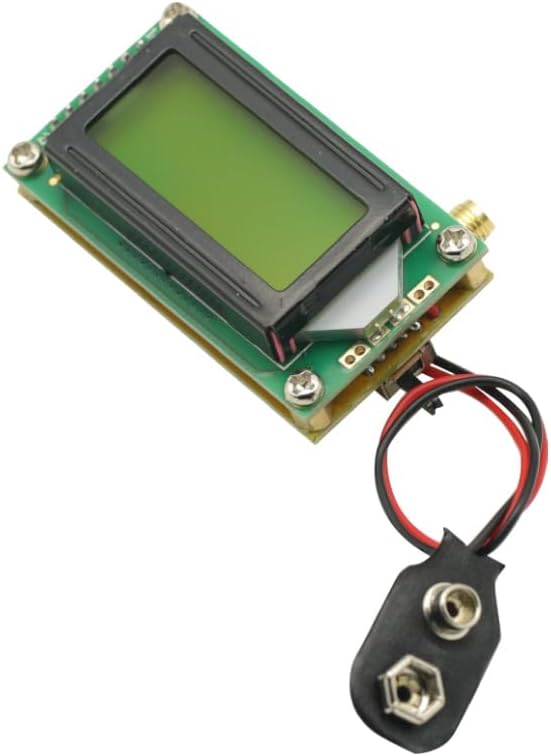
This unit is an excellent choice for those on a tight budget with specific VHF and UHF needs. It measures frequencies in these common bands accurately with minimal fuss or setup.
We may earn a commission when you buy through this link, at no additional cost to you.
Operation is straightforward: just press the button to test after powering on. The device is small enough to fit in a pocket or small tool bag easily.
While it lacks wide-band capabilities, it excels in simplicity for targeted tasks. The 9V battery and antenna are included, ready for immediate use out of the box.
For casual operators needing occasional checks without complex features, this is the go-to budget pick. It balances cost and function well for focused frequency testing requirements.
Long press powers the unit, and short presses cycle through test results for quick readings.
Measuring just 9cm by 5.5cm by 2cm it offers exceptional portability for any workspace.
We may earn a commission when you buy through this link, at no additional cost to you.
Anysecu markets this as an upgrade to previous models, and its 4.2 rating confirms its reliability. The extended range up to 2.8GHz covers most amateur and commercial communication bands effectively.
We may earn a commission when you buy through this link, at no additional cost to you.
Maintenance personnel find the signal strength indicator particularly useful for diagnosing weak links. The four-button interface is intuitive enough for quick adjustments without extensive manuals.
It is designed to count continuous wave signals from two-way radios accurately. The compact size ensures it does not become a burden during field operations or long sessions.
This model is ideal for technicians who need a dependable tool for routine checks. Its balance of range and usability makes it a strong contender in the mid-range category.
Supporting frequencies up to 2.8GHz makes it suitable for modern broadband radio systems.
Four clearly labeled buttons simplify operation so users can focus on testing instead of menus.
We may earn a commission when you buy through this link, at no additional cost to you.
This handheld counter features a TCXO oscillator that maintains accuracy across temperatures, rated at 4.3 stars. It serves as a precise tool for maintenance personnel verifying transmit frequencies on various devices.
We may earn a commission when you buy through this link, at no additional cost to you.
The device warns users about low battery levels to prevent interruptions during critical measurements. It covers 2MHz to 2.8GHz, accommodating VHF, UHF, and 2m ham radio bands effectively.
While it handles signals well, care is needed to avoid direct antenna output which can exceed 5V input limits. The small form factor ensures it is easy to carry anywhere.
If temperature stability is a priority for your setup, this model offers a solid solution. Its reliable performance and intuitive controls make it a favorite for professional enthusiasts.
The TCXO ensures readings stay accurate between minus 45 and 65 degrees Celsius reliably.
A graphical battery level display alerts you when power is low so you never miss a test.
We may earn a commission when you buy through this link, at no additional cost to you.
This module is designed for hobbyists building their own projects rather than standalone use. With a 3.1 rating, it offers basic frequency counting capabilities suitable for simple integration tasks.
We may earn a commission when you buy through this link, at no additional cost to you.
The display is limited to decimal precision that may not satisfy high accuracy needs. However, for DIY kits where cost is paramount, it provides a functional starting point.
Material construction uses standard PCB FR4 which ensures basic durability. It fits into custom enclosures but requires additional assembly to become a usable device.
Choose this only if you plan to build a custom unit around the module. For ready-to-use tools, other options provide better performance and immediate usability out of the box.
This module suits builders who want to incorporate frequency counting into custom electronics projects.
An 0802 LCD provides clear numeric readouts though decimal accuracy is limited compared to higher end units.
We may earn a commission when you buy through this link, at no additional cost to you.
Rated at 3.6, this board is a cost-effective option for prototyping or educational purposes. It focuses on low power consumption making it suitable for battery-powered custom projects.
We may earn a commission when you buy through this link, at no additional cost to you.
The LCD display is included to show results directly on the board. While the range tops out at 500 MHz, it covers many common amateur bands well.
It is new and packaged for integration into larger ham radio kits. However, it lacks the robustness of handheld commercial units for daily field use.
This option works well if you need a simple block for custom designs. For a complete tool ready to use immediately, consider the standalone handheld models in this guide.
Low power consumption makes this board ideal for battery operated test setups or portable designs.
The board is sold as new for straightforward integration into custom ham radio testing kits.
We may earn a commission when you buy through this link, at no additional cost to you.
This premium counter receives a perfect 5.0 rating due to its unmatched precision and features. Designed for serious engineers, it offers 40ps resolution for detailed phase and time interval measurements.
We may earn a commission when you buy through this link, at no additional cost to you.
The built-in GPS disciplined oscillator provides long-term stability that rivals benchtop equipment. Dual channel measurement allows simultaneous tracking of two signals for comparative analysis tasks.
Advanced functions like ADEV and FFT analysis are available directly on the 4-inch touchscreen. Data can be exported via USB or SD card for further processing on a computer.
While it comes with a higher price tag, it delivers lab-quality results in a portable form. For professional calibration and SDR tuning, it is the undisputed choice among all reviewed options.
GPS discipline ensures frequency accuracy stays consistent over long periods without manual recalibration.
Built-in tools like histograms and FM deviation analysis provide deep insights beyond simple counting.
We may earn a commission when you buy through this link, at no additional cost to you.
Selecting the right frequency counter requires understanding your specific measurement needs and technical requirements. This guide outlines key factors to help you choose a device that matches your operational style and budget constraints.
Ensure the device covers the specific bands you operate on, whether VHF, UHF, or HF. Some models stop at 500MHz while others go up to 7GHz depending on their intended use case.
Choose a range that matches your typical usage to avoid buying unnecessary high-end specs or underpowered units.
Look for units with temperature compensated oscillators like TCXO or GPS disciplined oscillators for better stability. High precision models offer resolution down to picoseconds for detailed phase analysis.
Higher accuracy ensures you remain compliant with frequency regulations and maintain signal integrity.
Consider whether you prefer a touchscreen or physical buttons for operation. A clear LCD or touchscreen helps in reading values quickly in various lighting conditions.
User-friendly controls simplify testing and reduce the time needed to interpret measurement results.
If you work in the field, the size and weight of the counter matter. Handheld units are generally lighter and easier to carry than benchtop instruments.
Check battery life and options for external power to ensure continuous operation during long sessions.
Verify the maximum input voltage the device can handle to avoid damage from strong signals. Some counters require attenuators for high-power transmitters.
Ensure the connectors match your setup, typically SMA or similar RF connectors, for secure cable connections.
Look for decoders like CTCSS or DCS if you need to identify specific tones in signals. Signal generators or spectrum analysis capabilities add versatility for broader testing.
These features can eliminate the need for separate tools and streamline your testing workflow.
Determine how much you are willing to spend based on your needs. Entry-level units are affordable but may lack advanced features found in premium models.
Investing in a slightly higher-end device often pays off through better durability and accuracy over time.
Check for warranty length and manufacturer support options before purchasing. Good support can save money if the unit develops issues later.
A longer warranty period often indicates higher confidence in the product's build quality.
Connect your signal source to the counter via the appropriate RF cable or antenna. Ensure the input voltage is within the safe limits specified in the user manual to prevent internal damage.
Power on the device and select the frequency range that covers your signal. Use the range buttons to narrow down the display for better resolution and accuracy in your readings.
After finishing use, clean the unit with a soft cloth and store it in a dry place. Regularly check the battery levels and replace or recharge them to ensure it is ready for next time.
Most amateur radio operators focus on VHF and UHF bands which range from 136 to 960 MHz. However, if you work with HF or higher frequency services, a wider range up to 3GHz or more is recommended.
A frequency counter measures specific frequencies accurately while a spectrum analyzer shows signal strength across a range. If you need to visualize interference, a spectrum analyzer is better, but counters are simpler for basic checks.
Standard handheld counters offer accuracy within a few parts per million, which is sufficient for most hobbyist use. For critical measurements, look for models with TCXO or GPSDO stability to minimize drift.
Yes, these counters can measure the center frequency of FM signals as long as they are continuous wave carriers. Note that they may not show deviation or modulation depth details like specialized tools.
Check for loose cable connections and ensure the signal source is not overloaded. Moving the counter further from the transmitter can sometimes improve stability by reducing input signal strength.
If you require long-term stability or perform calibration tasks, a GPSDO is worth the investment. For general use, standard TCXO models provide enough accuracy without the higher price tag.
Some advanced models allow USB data export that integrates with software analysis tools. Check the specifications for SCPI commands or logging features if you want to automate measurements.
Most handheld units accept up to 5 volts peak-to-peak directly at the input. Always use an attenuator or antenna when connecting to transmitters to avoid exceeding this limit.
We reviewed ten models ranging from budget-friendly handhelds to precision lab instruments like the AURSINC TinyGTC. Whether you need simple checks or complex analysis, there is a model here to suit your needs.
Prioritize frequency range and accuracy based on your specific operations before buying. Portability matters if you travel frequently, while stability becomes critical for technical calibration work.
Prices change often so always check current listings before finalizing your purchase. The models listed offer a reliable selection to help you maintain your equipment with confidence and precision.