
Entina Tina2C
4.4Editor score
Compact mini size
STEM modules included
App controlled
Explore the top 3D printers for educational use this October. We compare speed, safety, ease of use, and features to help schools and parents choose the right
Finding the right 3D printer for educational use requires balancing speed, safety, and ease of setup. Schools and parents need machines that inspire creativity without causing frustration or safety hazards in shared spaces.
We evaluated ten leading models based on automation, build quality, and educational features like AI tools and STEM modules. Our analysis focuses on reliability, print success rates, and user-friendly interfaces suitable for classrooms.
Each pick highlights specific strengths for learning environments, from beginner-friendly starters to advanced multi-color systems. Please note that pricing and availability can change rapidly, so verify current details before purchasing.
4.4Editor score

4.7Editor score

4.6Editor score
This side-by-side comparison highlights key specifications and unique features across the ten selected models to help you identify the best fit for your educational needs.





The Bambu Lab A1 stands out as the top choice for educational environments due to its seamless automation and high performance. It delivers fast, precise prints with minimal user intervention, making it ideal for students who need reliable results.
We may earn a commission when you buy through this link, at no additional cost to you.
Its full-auto calibration eliminates tedious manual setup, ensuring every print starts correctly. The acceleration of 10,000 mm/s² allows for rapid project completion, keeping students engaged. Active flow rate compensation guarantees smooth layers and consistent quality.
While the AMS lite accessory is separate, the base unit remains highly capable for monochrome projects. The quiet operation and user-friendly touchscreen make it suitable for shared learning spaces without disruption.
Educators and parents should choose this model for its balance of speed, ease, and reliability. It simplifies the learning curve while offering room to grow with multi-color capabilities when ready.
Full-auto calibration handles Z-offset and bed leveling, letting students start printing immediately without technical adjustments.
Adding the AMS lite unlocks vibrant multi-color prints, enabling more creative and educational design projects.
We may earn a commission when you buy through this link, at no additional cost to you.
The Entina Tina2C is designed specifically for kids and beginners, offering a friendly entry into 3D printing. Its compact size and quick setup make it perfect for home desks or small classroom stations.
We may earn a commission when you buy through this link, at no additional cost to you.
With a library of over 3,000 models and 20+ DIY STEM modules, it provides extensive educational content. The AI-powered app helps users find and customize prints easily, enhancing the learning experience.
The small build volume limits large projects, but it is sufficient for most educational toys and prototypes. Quiet operation and safety features ensure it fits well in home and school environments.
This printer is an excellent budget-friendly option for introducing 3D printing to young learners. It prioritizes ease of use and educational content over advanced technical features.
Regularly updated courses and interactive tools turn printing into an engaging STEM learning journey for kids.
Supports both WiFi and offline TF card printing, giving users flexibility in different classroom settings.
We may earn a commission when you buy through this link, at no additional cost to you.
The Ugee Funbox delivers a premium, safe experience tailored for children and educational settings. Its UL GREENGUARD certification and fully enclosed design prioritize air quality and physical safety.
We may earn a commission when you buy through this link, at no additional cost to you.
AI-powered tools allow kids to convert text, photos, or voice into 3D models instantly. The massive library of 12,000+ toys and projects encourages continuous creativity and exploration.
Although limited to single-color PLA, the focus on safety and ease outweighs this trade-off for younger users. The quiet operation and touch-friendly interface make it a stress-free creative companion.
Investing in the Funbox means providing a secure, engaging platform for STEM learning. It removes technical barriers so children can focus on design and imagination.
Anti-pinch doors, cool-touch exterior, and HEPA filtration ensure a safe environment for young learners.
Built-in AI engines turn ideas into printable models quickly, fostering creativity without complex software.
We may earn a commission when you buy through this link, at no additional cost to you.
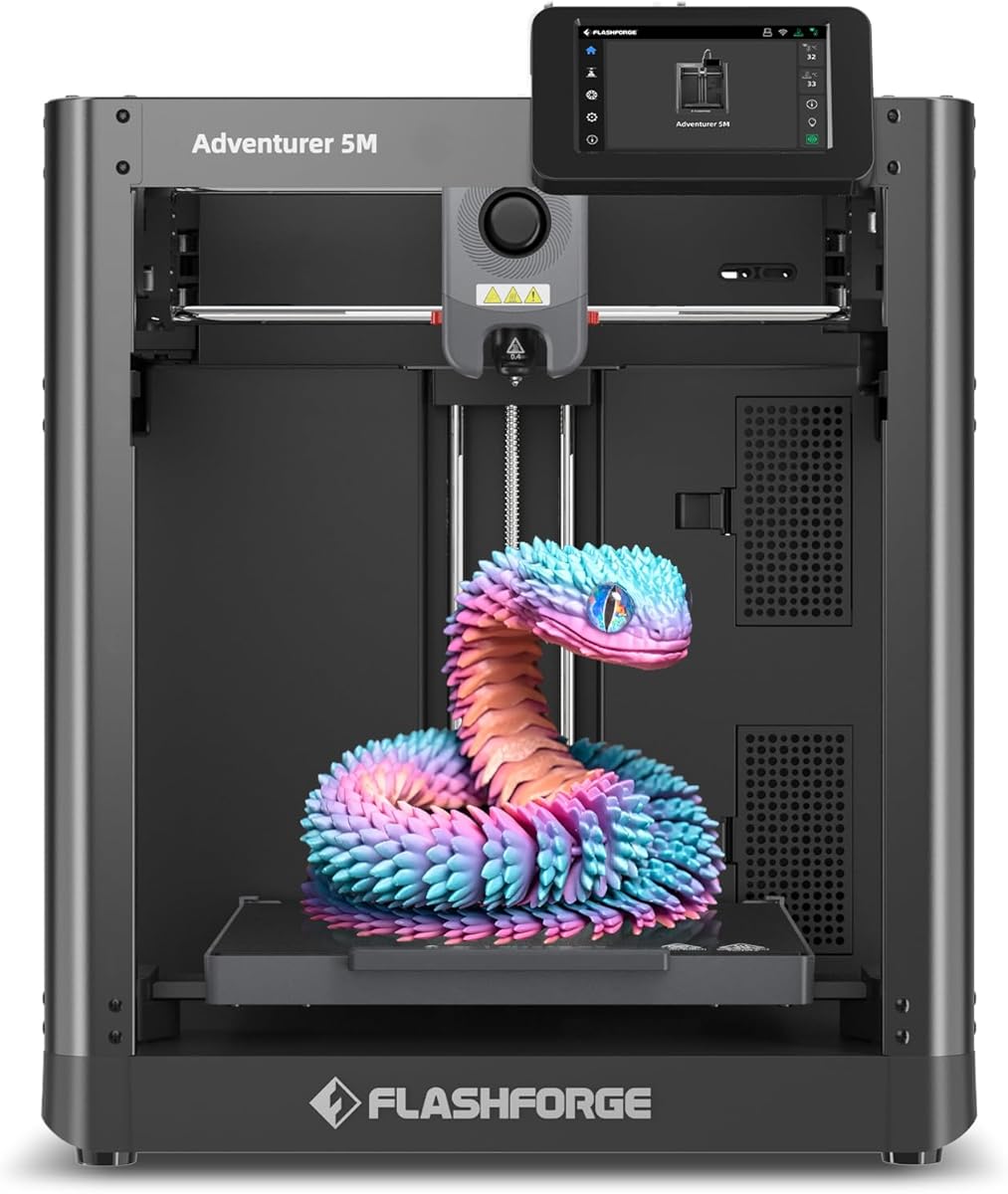
The FLASHFORGE Adventurer 5M offers impressive speed and efficiency for educational prototyping. Its CoreXY metal structure and auto leveling help achieve consistent results quickly.
We may earn a commission when you buy through this link, at no additional cost to you.
With a max speed of 600mm/s, students can complete multiple iterations in a short period. The app monitoring feature allows remote tracking, which is useful for managing class projects.
However, its lower rating suggests potential reliability issues. The open design requires supervision to ensure safety during operation in shared spaces.
It is best suited for advanced students or settings where speed is prioritized. Educators should weigh the benefits against the need for supervision and maintenance.
High acceleration and speed reduce wait times, allowing more time for design and iteration.
The Flash Studio app lets educators track print progress and receive alerts from anywhere.
We may earn a commission when you buy through this link, at no additional cost to you.
The FLASHFORGE AD5M combines speed and durability, making it suitable for technical education. Its automatic calibration ensures accurate prints with minimal manual effort.
We may earn a commission when you buy through this link, at no additional cost to you.
The CoreXY structure provides stable, low-noise performance even at high speeds. Power loss recovery protects ongoing projects from interruption, saving time and materials.
While it lacks an enclosure, the build quality supports various filaments. The network monitoring allows classroom management of multiple units simultaneously.
This model is ideal for students ready to learn engineering principles. It balances affordability with professional-grade features for deeper technical learning.
In event of outage, the printer saves progress and resumes automatically when power returns.
Orca-flashforge slicer enables multi-printer monitoring, useful for managing class labs.
We may earn a commission when you buy through this link, at no additional cost to you.
The Bambu Lab P1S offers a fully enclosed build chamber, making it ideal for engineering materials like ABS or ASA. This containment improves print quality and safety in classrooms.
We may earn a commission when you buy through this link, at no additional cost to you.
Setup takes just 15 minutes, allowing immediate use for lessons. Its high speed and auto leveling ensure consistent, professional results for student projects.
While more expensive, the reliability and multi-color potential justify the investment for advanced programs. It supports a wide range of filaments for diverse educational applications.
Choose the P1S for programs requiring advanced materials or color prints. It provides a robust platform for serious technical and creative projects.
The enclosure allows safe printing of engineering-grade filaments beyond basic PLA.
Connecting AMS enables up to 16 colors, unlocking complex design possibilities.
We may earn a commission when you buy through this link, at no additional cost to you.
The P2S Combo comes ready with the AMS 2 Pro, enabling seamless multi-color printing out of the box. This eliminates the need for separate purchases and simplifies setup.
We may earn a commission when you buy through this link, at no additional cost to you.
Its adaptive airflow system maintains optimal temperatures for various materials. The included filament dryer ensures quality prints by preventing moisture issues.
This system is best for advanced makers or vocational programs. It offers the most complete solution for professional-grade educational outputs.
While expensive, the comprehensive package saves time and effort. It supports high-quality results for capstone projects and demonstrations.
The AMS 2 Pro enables vibrant, multi-material prints without extra steps or costs.
Built-in drying keeps filaments in top condition for consistent results.
We may earn a commission when you buy through this link, at no additional cost to you.
This variant of the Adventurer 5M emphasizes speed with minimal setup. The auto leveling ensures a perfect first layer every time without manual adjustments.
We may earn a commission when you buy through this link, at no additional cost to you.
Its CoreXY system and vibration compensation deliver high-quality prints quickly. Filament run-out sensors protect projects from unexpected stops.
The open design is not ideal for unsupervised environments. Careful placement and monitoring are necessary in classroom settings.
For workshops where speed is key, this model performs well. It offers solid value for educational settings focused on rapid iteration.
Acceleration and compensation ensure prints are fast without sacrificing surface quality.
Run-out sensors detect empty spools and pause printing automatically.
We may earn a commission when you buy through this link, at no additional cost to you.
The Snapmaker U1 supports four independent toolheads, enabling true multi-material prints without manual swaps. This is unique for creating complex assemblies in a single run.
We may earn a commission when you buy through this link, at no additional cost to you.
Its tool changer switches in just 5 seconds, minimizing downtime. Smart calibration ensures accuracy across all tools and materials.
This system is best for specialized vocational or engineering labs. It allows students to explore advanced concepts like support structures and dual-material designs.
While costly, the versatility justifies it for specific applications. It opens doors to sophisticated project outcomes for advanced learners.
Combine flexible and rigid materials or soluble supports for advanced prototyping.
Automatic tool changes save time and reduce errors during complex prints.
We may earn a commission when you buy through this link, at no additional cost to you.
The A1 Mini combines a small footprint with the powerful features of the larger A1. It fits easily on desktops, making it ideal for individual student stations.
We may earn a commission when you buy through this link, at no additional cost to you.
Its auto calibration and quiet operation create a smooth experience. The combo includes the AMS lite for multi-color projects without extra purchases.
The small build volume limits larger projects, but works well for detailed models. It is a compact solution for schools with limited space.
Choose the Mini for space-constrained environments or personalized learning. It retains the reliability and ease of the A1 in a smaller form.
Compact design allows placement in classrooms with limited room for equipment.
Noise cancellation keeps the environment quiet for focus during class.
We may earn a commission when you buy through this link, at no additional cost to you.
Choosing the right 3D printer involves evaluating safety, ease of use, and educational features that match your students age and skill levels.
Safety is paramount in educational settings. Look for fully enclosed models with cool-touch exteriors and HEPA filtration to prevent fumes and hot surface burns. Models certified by UL GREENGUARD ensure low emissions for indoor use.
Always prioritize closed designs for younger students or unsupervised environments.
Manual bed leveling can be frustrating for beginners. Select printers with fully auto leveling or one-click calibration to ensure reliable first layers without manual adjustments. This allows more focus on design rather than machine tuning.
Automation features significantly reduce downtime and improve success rates in classrooms.
Educational projects often require multiple iterations. High speeds like 500mm/s help complete prints quickly, keeping students engaged. Match the build volume to project needs; compact sizes work for toys, while larger areas support engineering prototypes.
Balance speed with quality to ensure projects finish within class time limits.
Printers that include STEM modules or app-based learning libraries add value beyond hardware. AI features that convert text or images to 3D models can inspire creativity without complex CAD skills.
Software ease determines how quickly students transition from concept to creation.
Multi-color capabilities encourage detailed design and artistic expression. Systems with automatic changers avoid manual filament swapping, which can be error-prone. However, assess if this feature is necessary for your specific curriculum.
Invest in multi-material systems only if your program requires complex prototypes.
Classroom printers must handle frequent use. Models with all-metal structures and robust nozzles reduce wear. Features like power loss recovery prevent material waste during interruptions.
Reliable hardware ensures less time spent on repairs and more on teaching.
Consider long-term costs including replacement nozzles and filaments. Entry-level printers are affordable but may lack durability. Mid-range models often provide the best balance for educational longevity.
A higher upfront cost may save money through better performance and fewer failed prints.
Begin by placing the printer on a stable, level surface away from high-traffic areas. Ensure the room has adequate ventilation to manage any odors or fumes produced during printing, especially with enclosed models.
Regularly clean the build plate using isopropyl alcohol to remove residue that can affect adhesion. Check nozzles for clogs and replace them if print quality drops. Follow manufacturer guides for scheduled maintenance tasks.
Teach students basic safety protocols, such as avoiding contact with hot parts and supervising operations. Use the built-in cameras or apps to monitor progress without disturbing the classroom workflow.
Yes, when proper precautions are taken. Choose enclosed printers with certified safety ratings to reduce fumes. Always supervise printing sessions and keep hot parts out of reach.
It varies by size and detail. A small figurine might take one hour, while complex parts could take several. High-speed printers help reduce wait times significantly.
Most printers include user-friendly apps or compatible slicers like Cura. Educational models often feature simplified interfaces that require minimal technical training to use.
PLA is the safest and easiest to use for beginners. Avoid ABS unless using an enclosed printer with ventilation. TPU offers flexibility but is harder to print.
Use auto-calibrated printers to ensure good adhesion. Keep filament dry and avoid drafts near the printer. Teach students to monitor first layers closely.
Yes, many models support simple design tools or import standard STL files. AI tools on some printers even allow creating models from text or images easily.
Basic care includes nozzle cleaning and bed leveling. Automatic models need less frequent adjustment. Check filters and fans regularly for optimal performance.
The Bambu Lab A1, Entina Tina2C, and Ugee Funbox lead our list for their balance of performance, safety, and educational features. Each serves different age groups and learning objectives effectively.
Prioritize safety and automation when selecting a model for shared spaces. Ease of use ensures that educators spend more time teaching and less on technical troubleshooting.
Always verify current pricing and warranty details before purchasing to ensure you get the best value for your specific program needs.