
HiLetgo 5pcs DHT11 Temperature Humidity Sensor Module
4.5Editor score
Single-wire wiring scheme
Pre-calibrated digital output
Low cost package
Discover the top Arduino temperature sensor options for your projects. We compare accuracy, range, and features to help you choose the right module.
Selecting the right sensor is crucial for any embedded system project. You need reliable data to make informed decisions about your environment. Whether you are building a weather station or a thermostat, the right component matters.
We have evaluated ten popular modules based on technical specifications and user feedback. Our analysis covers accuracy, operating ranges, and communication protocols. This ensures you find a part that fits your specific development needs.
Each pick highlights unique strengths like waterproofing or digital output. Please note that pricing and availability can change over time. Always verify current details before finalizing your purchase decision.
4.5Editor score

4.7Editor score

4.9Editor score
The following table provides a side-by-side overview of the top ten models available for Arduino integration.




This module offers excellent accuracy for demanding environmental monitoring tasks. It combines temperature and humidity sensing in a compact digital format. The ratings reflect its reliability in various project applications.
We may earn a commission when you buy through this link, at no additional cost to you.
The SHT31 chip provides precise readings with minimal drift over time. You benefit from a wide operating range that supports extreme conditions. This makes it suitable for both indoor and outdoor setups.
While the price is higher than basic options, the performance justifies the investment. The I2C interface simplifies wiring compared to single-wire solutions. This reduces clutter on your microcontroller breadboard.
Developers seeking professional grade results should consider this model. It delivers consistent data for critical systems like climate control. Its robust construction ensures long-term stability in active projects.
The wide operating range allows deployment in extreme cold or heat without failure.
I2C protocol reduces pin usage and simplifies code implementation for beginners.
We may earn a commission when you buy through this link, at no additional cost to you.
This sensor provides a cost-effective entry point for new developers. The kit includes five modules to support multiple experiments or projects. It is widely supported by libraries and tutorials online.
We may earn a commission when you buy through this link, at no additional cost to you.
Integration is simple due to the single-wire communication scheme. The module comes with a bypass capacitor and pull-up resistor. This reduces the need for external components on your circuit.
Accuracy is sufficient for general hobbyist applications but not for science. The range is limited to indoor environments mostly. However, the low cost offsets these limitations for learning purposes.
It remains a top choice for budget-conscious makers and students. You get reliable basic data without spending much money. The included wires make initial setup faster and easier.
On-board components mean fewer external parts are needed for a working circuit.
Getting five units allows you to share with friends or test multiple locations.
We may earn a commission when you buy through this link, at no additional cost to you.
This package is designed for users needing robust measurement capabilities. The probes are sealed against water and corrosion effectively. You get everything needed to start measuring immediately.
We may earn a commission when you buy through this link, at no additional cost to you.
The stainless steel casing protects the sensor in wet environments. Accuracy is high enough for industrial or agricultural applications. The included adapter boards simplify connection to your controller.
While costlier than basic boards, the durability offers better value. You avoid the risk of sensor failure in harsh conditions. The range supports extreme temperatures found in ovens or freezers.
Professionals and serious hobbyists should choose this for reliability. It stands up to physical stress better than plastic alternatives. The complete kit saves time on sourcing extra parts.
Sealed stainless steel protects the internal electronics from moisture damage.
Adapters and resistors are included to reduce setup complexity significantly.
We may earn a commission when you buy through this link, at no additional cost to you.
This module stands out with flawless user feedback ratings. It upgrades older models with better precision and connectivity. The I2C output simplifies integration with multiple devices.
We may earn a commission when you buy through this link, at no additional cost to you.
The sensor chip delivers very high resolution readings. You can detect small changes in environmental conditions reliably. This is ideal for weather stations or climate control projects.
Power consumption is low which helps for battery powered designs. The voltage range adapts easily to common logic levels. However, it offers fewer units than some bulk packs.
Choose this if precision is your top priority for the build. The performance metrics exceed many competitors in this class. Its ease of use makes it friendly for all skill levels.
Fine-grained output allows you to see minute fluctuations in temperature data.
Low current draw extends battery life in remote monitoring installations.
We may earn a commission when you buy through this link, at no additional cost to you.
This set offers a convenient module and probe combination. The waterproof cable reaches distant monitoring points easily. It simplifies wiring for users needing a complete solution.
We may earn a commission when you buy through this link, at no additional cost to you.
You get three distinct sets to cover multiple zones. The wide range supports freezing or boiling temperatures safely. The 1-Wire interface keeps pin usage to a minimum.
The adapter module makes connection simpler than bare probes. It includes the pull-up resistor needed for operation. This reduces the chance of wiring errors during setup.
Select this for general monitoring tasks requiring durability. The balance of features and cost fits most needs well. It provides a solid foundation for DIY temperature projects.
The one meter lead provides reach to tanks or pipes without stretching.
Plug-in modules remove the need for soldering wires to sensor pins.
We may earn a commission when you buy through this link, at no additional cost to you.
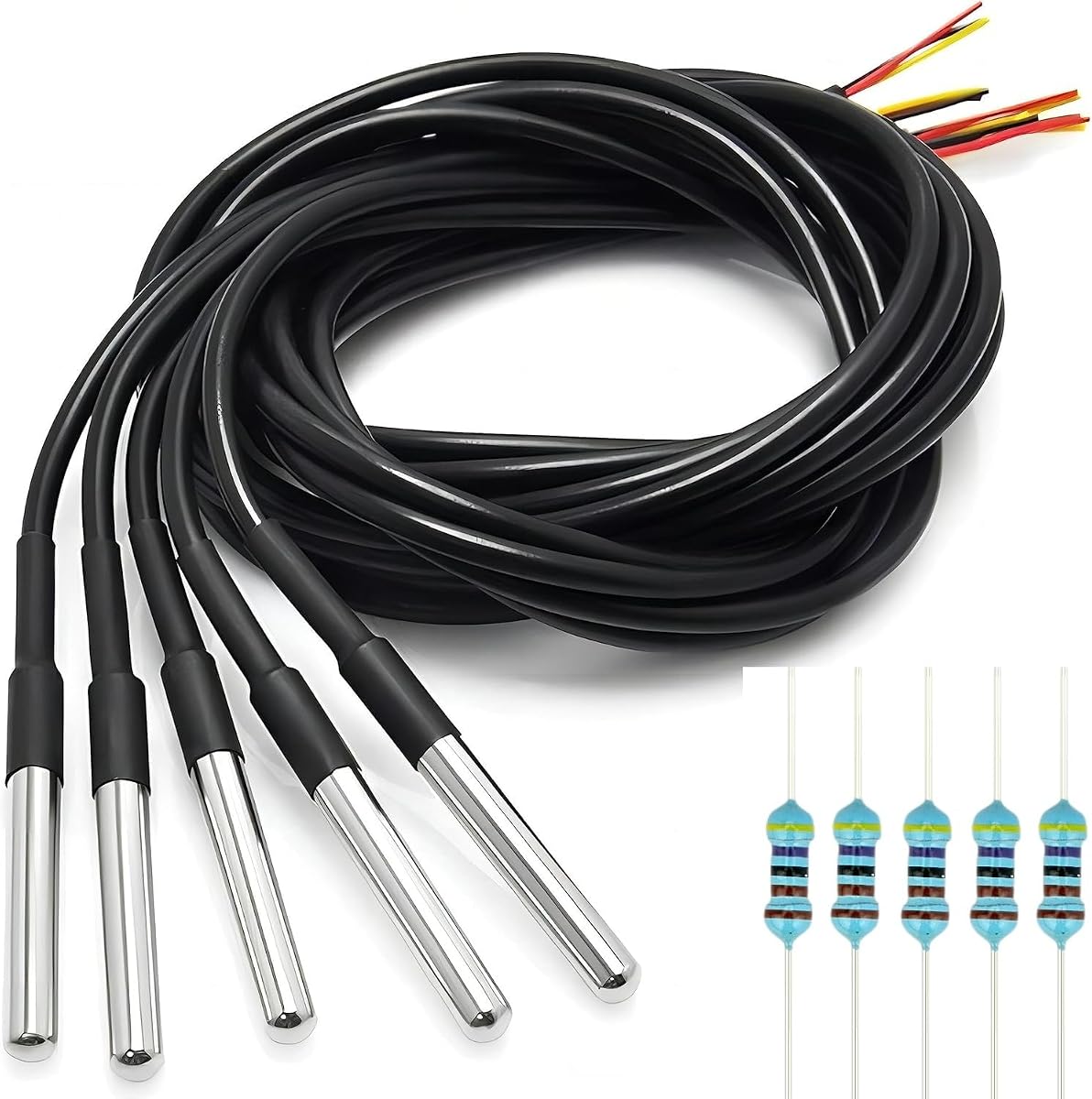
This option focuses on quantity and value for large projects. You receive five waterproof probes with essential resistors. This allows scaling up sensor coverage without extra purchases.
We may earn a commission when you buy through this link, at no additional cost to you.
The probes maintain accuracy across the full temperature range. Waterproofing ensures reliability in moist or submerged areas. The resistors are included to meet bus requirements.
While it lacks a breakout board, wiring is straightforward. The voltage support is wide enough for most boards. You save money by buying in bulk directly.
Large scale deployments benefit from this kit choice. It is ideal for agricultural or industrial sensor arrays. The value proposition is hard to beat for many users.
Multiple units enable monitoring several zones simultaneously with one order.
Resistors save you from sourcing separate parts for the bus line.
We may earn a commission when you buy through this link, at no additional cost to you.
This kit is a standard choice for introductory electronics classes. The module form factor saves time on assembly work. It is compatible with most common microcontroller platforms.
We may earn a commission when you buy through this link, at no additional cost to you.
The digital output simplifies reading data from the sensor. You get two units to test redundancy or comparison. The wires provided make initial prototyping much easier.
Limitations include a narrow temperature and humidity range. It works best for standard room conditions. However, the simplicity helps users understand sensor basics quickly.
Students and beginners will find this very suitable. It offers the essential features needed to start learning. The included wires remove the frustration of cable management.
Simple wiring and documentation make it easy to learn from.
Supports Arduino and Raspberry Pi without complex configuration steps.
We may earn a commission when you buy through this link, at no additional cost to you.
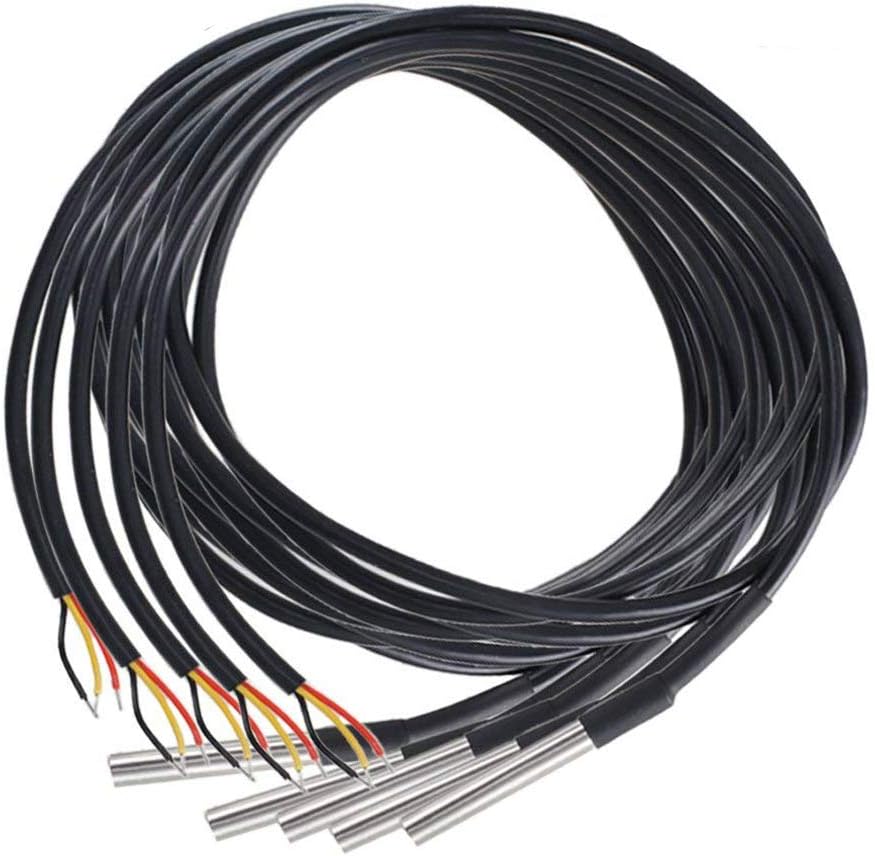
This pack is designed for extensive temperature monitoring. You get five probes with long leads for flexibility. The single bus interface allows multiple sensors on one wire.
We may earn a commission when you buy through this link, at no additional cost to you.
The stainless steel casing provides good protection. Leads reach far into enclosures or tanks without strain. Voltage range is broad to support various power sources.
You will need to source pull-up resistors separately. This adds slight complexity for those wanting plug and play. But the quantity and quality balance out well.
Use this for projects requiring distributed sensing points. It offers great value for multi-location thermal tracking. The consistency across sensors ensures reliable comparisons.
One meter cables allow placement far from the main controller.
Multiple probes on one pin reduce wiring clutter significantly.
We may earn a commission when you buy through this link, at no additional cost to you.
This module upgrades the standard DHT11 with better specs. The AM2302 chip offers improved accuracy and range. It handles full humidity ranges effectively for better data.
We may earn a commission when you buy through this link, at no additional cost to you.
The chip sensitivity is high enough for precise tasks. You get two modules with mounting holes for stability. This makes installation secure in fixed applications.
Accuracy is better than basic models but still not lab grade. It works well for weather stations or HVAC checks. The wider range supports colder environments than the standard 11.
Choose this when you need better data than DHT11. The chip provides reliability for serious hobbyist projects. It is a solid middle ground in the DHT family.
Full 0 to 100% range captures all environmental moisture conditions.
Screw holes allow permanent installation in enclosures or boxes.
We may earn a commission when you buy through this link, at no additional cost to you.
This kit offers a reliable solution for water based monitoring. The stainless steel case protects against rust and corrosion. Five units allow for extensive testing or sharing.
We may earn a commission when you buy through this link, at no additional cost to you.
The long cables facilitate placement away from electronics. It supports the full industry range for temperature. This versatility makes it good for many applications.
You will need to build or buy a breakout board. This step adds time to the initial setup. However the core component quality remains high and consistent.
Ideal for aquarium or heating system monitoring. The waterproofing ensures the sensor survives immersion. You get excellent value for five durable probes in one.
Stainless steel ensures long life even in chemically active water.
Suitable for liquid or air temperature measurement with care.
We may earn a commission when you buy through this link, at no additional cost to you.
Choosing the right sensor depends on your specific project requirements and environment.
Precision varies significantly between sensor types and models. Professional applications often require accuracy within 0.5 degrees Celsius. Hobbyist projects might accept +/- 2 degrees for general monitoring tasks.
Select a model that matches your precision needs to avoid overpaying.
Temperature ranges differ by component type and design. Some sensors are limited to indoor conditions. Others support extreme heat or cold for industrial use.
Verify the minimum and maximum ratings before purchasing your component.
Protocols like I2C and 1-Wire determine wiring complexity. I2C uses two wires and supports multiple devices easily. 1-Wire uses one wire but requires more careful pull-up resistor management.
Choose a protocol that matches your microcontroller pins and skills.
Some probes are waterproof while others are not. Look for stainless steel casing if you plan to use the sensor outdoors or in liquids. Plastic housing is fine for dry indoor air only.
Ensure the physical build can withstand your expected exposure conditions.
Most modules support 3.3V and 5V logic. However some newer chips may have tighter limits. Check the data sheet to ensure it matches your board voltage level.
Matching voltage prevents damage and ensures reliable communication signals.
Some kits include resistors and adapter boards while others do not. Kits with more accessories save you time on wiring. Buying bare probes might be cheaper but requires extra parts.
Decide if you want a ready to use solution or a bare component.
Prices vary based on brand and bundle size. Buying in bulk often reduces the cost per unit. Consider how many sensors you need now versus later.
Balance the initial price against the value of included accessories.
Widely used models have more code examples and tutorials online. This simplifies the development process significantly. Check if libraries exist for your specific sensor model.
Opt for popular models to speed up development and debugging.
Start by connecting the power pins VCC and GND to your board correctly. Ensure the voltage matches the sensor requirements to prevent damage.
Connect the data pin to a digital input on your microcontroller. For 1-Wire sensors include a 4.7K resistor between data and power.
Keep the sensor away from direct heat sources for accurate reading. Regular cleaning helps maintain long-term stability of the measurements.
The SHT31 series offers the highest accuracy among digital options. It provides ±0.3°C precision suitable for professional use. For cost effective solutions the AM2302 is also a strong choice.
Yes waterproof probes are designed for outdoor exposure. They resist rain and corrosion effectively. Ensure you use a protective cover for the electronics though.
Yes a pull-up resistor is required for the 1-Wire bus. Typically a 4.7K resistor connects the data line to VCC. Some adapter boards include this resistor internally for you.
DHT and SHT sensors measure both values simultaneously. They output digital signals for both parameters. This simplifies your code by requiring only one component.
The DS18B20 series supports temperatures down to -55°C. This makes it ideal for freezer monitoring or cold storage. Most DHT models stop working below freezing temperatures.
Pull-up resistors stabilize the digital signal lines. They ensure the signal returns to a known state when not active. Some boards include them to simplify wiring for users.
1-Wire sensors can chain up to 127 devices on one pin. I2C sensors can connect up to 116 devices on two pins. This allows extensive networks without needing extra pins.
We have reviewed ten reliable models that cover various needs. The SHT31 leads in precision while DHT11 offers simplicity. Waterproof DS18B20 probes stand out for harsh conditions.
Prioritize accuracy and durability based on your specific use case. Indoor projects can use simpler models to save money. Outdoor or industrial needs require waterproof and robust choices.
Always verify current pricing and availability before buying. Prices fluctuate over time and stock levels change. Choosing the right fit ensures your project runs smoothly.