Rad Triage 50
4.4Editor score
Wallet pocket sized
No batteries required
US Military grade
This guide compares the top dosimeters for personal radiation safety, evaluating accuracy, battery life, and features to help you choose the best monitor.
Radiation safety is a critical concern for many professionals and individuals today. A reliable dosimeter helps you monitor exposure to ionizing radiation effectively. Choosing the right device ensures you stay informed and protected in various environments.
We evaluated ten leading dosimeters based on accuracy, ease of use, and feature sets. Each product was selected for its ability to detect beta, gamma, and X-ray radiation. Our analysis focuses on real-world performance and user feedback to guide your decision.
Each pick highlights specific strengths like battery life, display quality, and alarm systems. Prices and availability can change frequently, so check current listings before purchasing. These tools provide peace of mind for anyone concerned about radiation exposure risks.
4.4Editor score

4.6Editor score

4.6Editor score
This side-by-side comparison highlights key specifications and features across all ten selected dosimeters to help you identify the best fit for your needs.


The GQ GMC-800 stands out as a top choice for serious radiation monitoring. With a 4.6 star rating, it offers high accuracy and user-friendly features that make it accessible for both professionals and enthusiasts.
We may earn a commission when you buy through this link, at no additional cost to you.
Its standout quality lies in the large color LCD display which provides clear readings under various lighting conditions. The device supports real-time and accumulated radiation tracking, ensuring you stay informed about exposure levels over time.
While the price is higher than basic models, the comprehensive feature set justifies the investment. Some users may find the menu system slightly complex at first, but the detailed instructions help navigate the functions efficiently.
Anyone needing reliable radiation safety equipment will benefit from this model. It is particularly suitable for fieldwork or home use where precise measurements and data logging are essential for long-term safety planning.
This device meets US national standards for accuracy ensuring reliable readings every time you use it.
Five alarm types including visual audio and vibration ensure you never miss a critical radiation alert.
We may earn a commission when you buy through this link, at no additional cost to you.
The GQ GMC-300S is a solid option for those who prioritize data tracking. It offers a 4.6 star rating and focuses on providing real-time and historical radiation data in an accessible format.
We may earn a commission when you buy through this link, at no additional cost to you.
Key strengths include the ability to log data every second into internal memory. This feature allows users to download history data to a computer for detailed analysis using the free software provided.
However, the smaller display might be less ideal for quick glances in bright sunlight. The alarm features are functional but less comprehensive compared to higher-end models in this comparison.
This device is best suited for users who need consistent monitoring and data records. It is a great choice for home safety or field inspections where detailed logs are more important than complex alarm systems.
Internal memory stores every second of data which can be downloaded for further review on your computer.
The rechargeable battery ensures long usage periods between charges making it reliable for extended fieldwork.
We may earn a commission when you buy through this link, at no additional cost to you.
Another variant of the GQ GMC-800 offers similar high-quality performance with a focus on portability. It maintains the 4.6 star rating and is designed for both personal and group use in various environments.
We may earn a commission when you buy through this link, at no additional cost to you.
Its standout feature is the portable design combined with a large color LCD display. This makes it easy to carry and read in different settings while ensuring clear visibility of radiation data.
The device offers multiple alarm types to ensure safety but lacks some of the advanced software features found in other models. The price remains consistent with other premium detectors in this category.
Anyone looking for a reliable and portable dosimeter will find this model suitable. It is perfect for travelers or professionals who need accurate readings without carrying bulky equipment.
Light and thin construction allows for easy carrying in a pocket or bag without adding significant weight.
The color display ensures readings are visible even in direct sunlight for outdoor monitoring applications.
We may earn a commission when you buy through this link, at no additional cost to you.
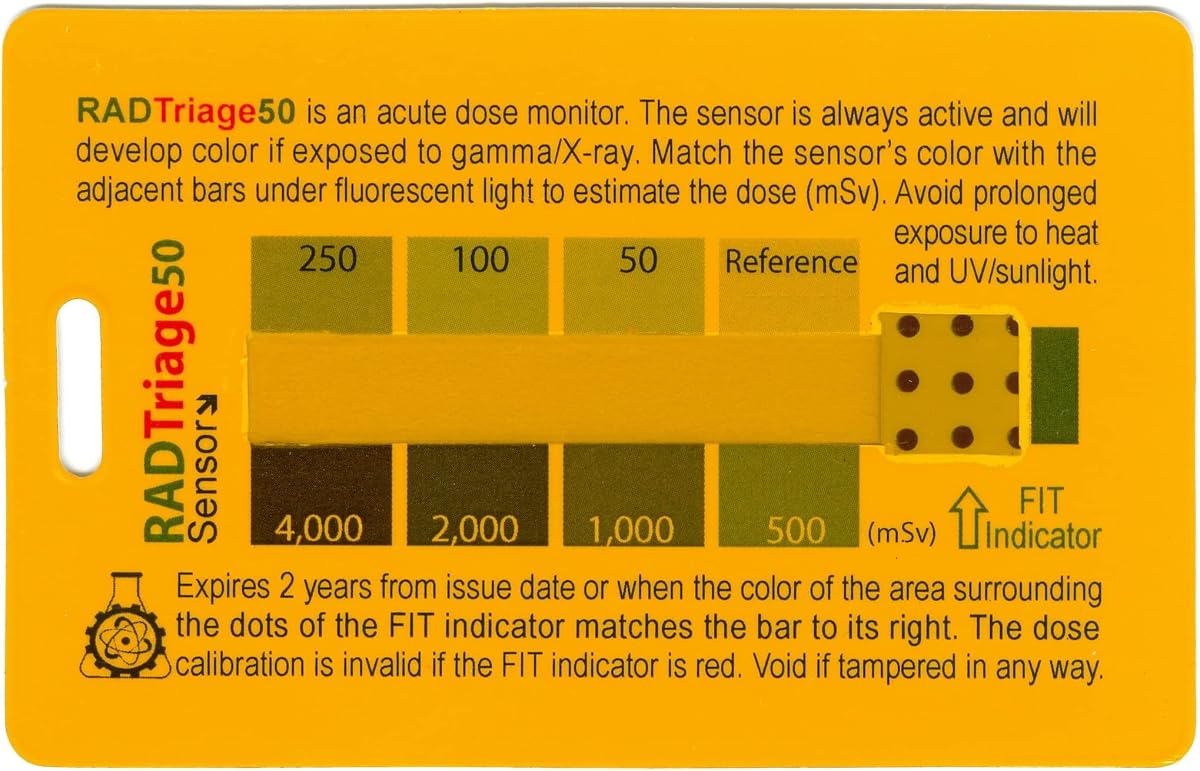
The Rad Triage 50 offers a unique solution as a disposable personal radiation detector. With a 4.4 star rating, it is ideal for those needing a reliable device without worrying about batteries or calibration.
We may earn a commission when you buy through this link, at no additional cost to you.
Its compact size allows it to fit in a wallet or badge holder making it highly convenient for everyday carry. It detects beta, gamma, and X-ray radiation effectively for emergency preparedness scenarios.
While it lacks digital readouts and is a one-time use device, its simplicity is its greatest strength. It is designed for immediate use in emergency situations where reliability is paramount.
This model is perfect for preppers or anyone needing a backup monitoring tool. It ensures you have a functional detector on hand without maintenance or charging requirements.
Ready to go out of the box ensures you have immediate protection without setup time in emergencies.
Military-grade construction ensures the device remains functional even after years of storage in a safe location.
We may earn a commission when you buy through this link, at no additional cost to you.
The APOWER RD-3 is a versatile detector with a 4.4 star rating suitable for various environments. It features a triple alarm system ensuring immediate awareness when radiation levels exceed safe thresholds.
We may earn a commission when you buy through this link, at no additional cost to you.
Its key strengths include an 8-day battery life and a clear color LCD display. These features make it reliable for extended use without frequent recharging needs.
However, the compact size might limit readability in bright conditions. The software features are basic compared to more advanced models but sufficient for general monitoring.
This device is best for casual users or home inspections. It provides essential protection and readings without the complexity of advanced data logging systems.
Up to 8 days on a single charge ensures continuous monitoring during long periods of use without interruption.
Visual audible and indicator light alarms ensure you are alerted even if you are not looking at the screen.
We may earn a commission when you buy through this link, at no additional cost to you.
The AEGTEST Radar-5633 offers an impressive 18-day battery life with a 3.9 star rating. It is designed for users who need long-term monitoring without frequent recharging interruptions.
We may earn a commission when you buy through this link, at no additional cost to you.
A key strength is the single screen display showing multiple data points simultaneously. This allows for easy tracking of dose rates and cumulative doses at a glance.
However, the lower user rating suggests some inconsistencies in performance or build quality. It lacks some of the advanced features found in higher-rated models in this list.
This device is suitable for basic monitoring needs. It is a good option for budget-conscious users who prioritize battery life over advanced data processing capabilities.
18 days of runtime on a single charge allows for extended fieldwork without the need for portable power.
Multiple data points on one screen provide comprehensive information without requiring navigation between menus.
We may earn a commission when you buy through this link, at no additional cost to you.
The HFS-50-CsI is the premium choice with a 4.6 star rating and CsI scintillator sensor technology. This provides superior accuracy and stability compared to traditional Geiger-Müller tube devices.
We may earn a commission when you buy through this link, at no additional cost to you.
Its standout features include a dynamic waveform display and an impressive 1700-hour battery life. These capabilities make it ideal for professionals needing precise data and extended monitoring periods.
While the price is the highest in this comparison, the superior sensor technology justifies the cost for serious users. It is heavier than some options but remains portable enough for field use.
Anyone requiring high-precision radiation monitoring will find this model essential. It is perfect for laboratory work or environmental surveys where accuracy is critical.
The CsI scintillator sensor offers superior stability and resistance to interference for more reliable readings.
A dynamic waveform curve display allows for intuitive viewing of radiation changes over time.
We may earn a commission when you buy through this link, at no additional cost to you.
The GQ GMC-500Plus offers professional-grade features with a 4.6 star rating. It uses dual Geiger tubes to push the detection range limits significantly higher than standard models.
We may earn a commission when you buy through this link, at no additional cost to you.
Key strengths include unlimited server logging and a large informative LCD display. These features make it suitable for professional applications where continuous data transmission is required.
However, the complex setup might be daunting for casual users. The higher cost reflects the advanced capabilities available for specialized monitoring tasks.
This device is best suited for professional or industrial use. It ensures high-range detection and reliable data management for critical environments.
Dual Geiger tubes allow for a detection range up to 10 times higher than standard single-tube models.
Unlimited server logging ensures all recorded data is automatically submitted to a server for storage.
We may earn a commission when you buy through this link, at no additional cost to you.
The MOESAPU FS5000 offers a 30-day battery life with a 4.2 star rating. It features a 2.4 TFT display that provides clear readings for various radiation types.
We may earn a commission when you buy through this link, at no additional cost to you.
Its strengths include audio-visual-haptic alerts ensuring you are always informed of changes in radiation levels. The long battery life is particularly beneficial for extended monitoring periods.
However, some users have reported issues with display visibility in bright sunlight. The overall rating reflects these minor drawbacks despite the strong feature set.
This device is suitable for users needing long-term battery performance. It is a good choice for extended fieldwork or home monitoring without frequent charging needs.
Up to 30 days of runtime on a single charge ensures continuous operation during long periods.
Audio visual and haptic alerts provide multiple ways to notify users of potential radiation hazards.
We may earn a commission when you buy through this link, at no additional cost to you.
The Soogua Geiger offers a versatile solution with a 4.2 star rating. It is designed for multiple applications including home improvement and imported food inspection.
We may earn a commission when you buy through this link, at no additional cost to you.
Key strengths include an all-round alarm system and a long battery life. These features make it a reliable companion for general radiation safety needs.
However, the lower rating suggests some limitations in precision or build quality. It lacks the advanced features found in higher-end models in this comparison.
This device is suitable for general monitoring tasks. It is a good choice for budget-conscious users needing a reliable basic detector for various applications.
Designed for multiple environments including home seafood and laboratory settings for broad usability.
Sound vibration light and display alerts ensure you are notified even if you are not looking at the screen.
We may earn a commission when you buy through this link, at no additional cost to you.
Selecting the right dosimeter depends on your specific needs and the environments you will be monitoring.
Accuracy is paramount when monitoring radiation. Look for devices that meet international or national standards like NIST. Calibration ensures the readings you see reflect true radiation levels.
Choose a device with documented calibration for reliable measurements.
Battery life determines how long you can use the device without recharging. For long-term monitoring, rechargeable batteries are essential. Some models offer weeks of use on a single charge.
Consider your typical usage patterns to match the battery capacity.
A clear display is crucial for reading data in various lighting conditions. Color LCD or TFT displays are often easier to read outdoors. Ensure the interface is intuitive for quick access to key metrics.
Prioritize screens that are visible in direct sunlight.
Reliable alarm systems alert you when radiation levels exceed safe limits. Look for models with multiple alarm types such as sound light and vibration. This ensures alerts are noticed even if you are distracted.
Adjustable alarm thresholds allow customization for different safety requirements.
Portability affects how easily you can carry the device in your pocket or bag. Lighter models are better for personal use while heavier ones may offer more features. Balance weight with functionality based on your needs.
Choose a form factor that suits your daily activities.
Data logging allows you to review historical radiation exposure. Some devices store data internally while others connect to software for detailed analysis. This feature is vital for long-term health monitoring.
Ensure the device supports easy data transfer for your records.
Different sensors like Geiger tubes or scintillators offer varying levels of sensitivity. Scintillators often provide faster response times and better accuracy. Select the type that aligns with your monitoring precision needs.
Match the sensor technology to your specific application environment.
Durability ensures the device withstands field conditions. Look for models with robust casings and protection against environmental factors. A sturdy build prolongs the device lifespan for consistent performance.
Invest in quality construction for long-term reliability.
Always start by reading the user manual thoroughly. Familiarize yourself with the interface and functions before use.
Keep the device away from extreme temperatures and moisture unless rated otherwise. Proper storage prolongs battery life and ensures accuracy.
Regularly check and update calibration if possible. For models with rechargeable batteries, avoid overcharging to maintain health.
Calibration frequency depends on usage and manufacturer recommendations. Generally annually is sufficient for casual users. Heavy users may need more frequent checks to maintain accuracy and ensure reliable readings.
Most models detect Beta Gamma and X-ray radiation which are common concerns. However some specialized devices may detect additional types. Check the product specifications to confirm detection ranges for your needs.
Battery life varies widely from days to weeks depending on the model. Rechargeable models often offer 7 to 30 days of runtime. Consider your usage patterns when selecting a device to avoid frequent charging.
Yes many modern dosimeters are designed for home safety and are sufficiently accurate. Look for devices with NIST compliance or similar certifications. This ensures reliable readings for everyday monitoring.
Store in a cool dry place away from direct sunlight. Avoid extreme temperatures to prevent battery damage. Keep the device in a protective case to prevent physical damage during storage.
Some models are specifically designed for liquid environments including wastewater. Check if the device is water-resistant or designed for submersion. Verify detection capabilities match the specific isotopes present.
A Geiger counter measures radiation intensity while a dosimeter tracks total accumulated exposure. Many modern devices combine both functions. This dual capability provides comprehensive safety information.
Yes dosimeters are safe to use daily and are designed for personal safety. They are passive monitoring tools that do not emit harmful radiation. Using one helps you understand your environment and stay safe.
Choosing the right dosimeter depends on your specific monitoring needs and environment. The top picks offer a range of options from budget-friendly to premium precision devices.
Prioritize accuracy battery life and display readability when making your decision. These factors ensure reliable monitoring and ease of use in various conditions.
Always check current prices and availability before purchasing as offerings may change. Investing in the right device provides peace of mind for radiation safety.