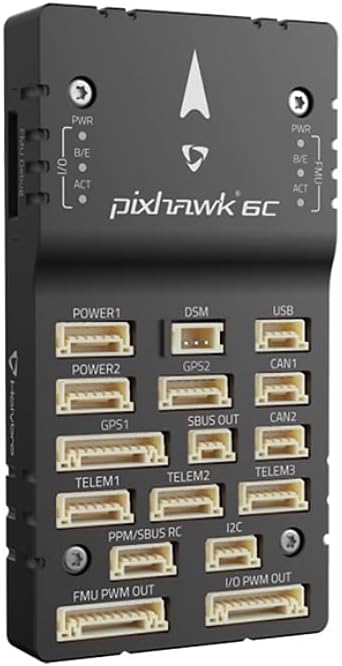
Pixhawk 6C Flight Controller, High-Performance STM32H743 480MHz Processor, Pre-Installed PX4 Autopilot Dual Redundant IMU & Vibration Isolation for UAV Drone (Plastic Case 6C)
STM32H743 processor
Dual redundant IMU
Vibration isolation system
This guide compares the top flight controllers for hybrid Vtol and Vtol drones, evaluating performance, firmware support, and features for reliable autonomous
Flight controllers serve as the brain of any unmanned aerial vehicle, and when it comes to hybrid Vtol or fixed wing drones, the stakes are even higher. These devices must seamlessly transition between vertical takeoff and forward flight while maintaining stability. Choosing the right controller ensures your build achieves peak performance without unnecessary complexity or cost.
We evaluated ten leading flight controllers based on processor power, firmware compatibility, sensor redundancy, and ease of integration. Each product was analyzed for its suitability in hybrid configurations, including VTOL, Vtail, and multirotor fixed wing combos. Our goal is to provide a clear overview of what each unit offers to both hobbyists and professionals.
Each pick in this list highlights specific strengths such as open source support, high frequency processing, or compact form factors. While we aim to present accurate data, prices and availability can change frequently on online marketplaces. Always verify current listings before purchasing to ensure you get the exact configuration you need for your specific drone project.

4.8Editor score

The following table provides a side by side comparison of all ten flight controllers reviewed in this guide. It outlines key specifications to help you quickly identify which unit matches your build requirements.



The KK 2.1.5 Flight Control Board stands out as a dedicated solution for VTOL and Vtail aircraft. With a perfect rating of 5.0, it promises excellent stability and control for model aircraft competitions and aerial photography projects.
We may earn a commission when you buy through this link, at no additional cost to you.
Its advanced flight control technology enables both self leveling and acrobatic flights, making it suitable for hobbyists seeking customizable features. The board is specifically designed to ensure stability and flexibility across different flight occasions including vertical takeoffs and landings.
While it offers strong stability and versatility, it lacks the modern GPS integration found in more recent open source controllers. This tradeoff is acceptable for pilots focused on manual maneuverability rather than autonomous waypoint navigation.
This controller is best suited for hobbyists who want to explore flight control systems without needing complex autonomous features. If your priority is stability during VTOL transitions and acrobatics, this board delivers reliable performance.
The board ensures stability and flexibility for vertical takeoffs and landings, which is critical for Vtail configurations that often struggle with balance.
It supports self leveling and acrobatic flights, allowing experienced users to tailor the flight profile to their specific aircraft requirements.
We may earn a commission when you buy through this link, at no additional cost to you.
The COREWING F405 V2 Flight Controller is designed specifically to fit RC airplanes and drones. While limited detailed information is provided, its designation suggests it is optimized for fixed wing platforms rather than multirotor hybrids.
We may earn a commission when you buy through this link, at no additional cost to you.
As a V2 version, it likely includes improvements over earlier models, offering better stability or processing power. Its primary focus seems to be on ensuring reliable performance for standard RC airplane builds.
Without detailed specifications on firmware or sensor redundancy, it is difficult to assess its full capabilities for hybrid VTOL applications. Buyers should verify compatibility with their specific drone frame and ESC setup.
This controller is best for pilots prioritizing fixed wing performance. If your project involves standard RC airplanes or simple drone conversions, it may offer a straightforward solution.
Designed to fit RC airplanes, this controller is likely tuned for fixed wing dynamics and aerodynamic efficiency rather than hover stability.
We may earn a commission when you buy through this link, at no additional cost to you.
The PIX 2-12S Mavlink SBUS PPM CRSF Flight Controller is a core board for PIX multi-rotor and fixed-wing VTOL systems. It features an STM32F405VGT6 main controller with integrated gyroscope, magnetometer, and barometer.
We may earn a commission when you buy through this link, at no additional cost to you.
Its support for 2 to 12S power supply makes it versatile for various battery configurations. The board includes GH1.25 connectors for GPS and receivers, ensuring compatibility with modern telemetry systems.
While it lists multiple sensors and robust power support, detailed firmware capabilities are not specified. Buyers should confirm if it meets their specific requirements for autonomous flight or advanced configuration.
This controller is ideal for DIY autonomous driving systems and VTOL builds requiring a solid sensor suite. It offers a strong foundation for complex setups needing high voltage support.
Supports 2 to 12S power supply, making it versatile for various battery configurations including high voltage setups common in performance drones.
Integrates MPU6500 gyroscope, VCM5883L magnetometer, and LPS22HB barometer for comprehensive flight data and navigation capabilities.
We may earn a commission when you buy through this link, at no additional cost to you.
The Pixhawk 2.4.8 PX4 Open Source Flight Controller is a master controller for fixed-wing, multi-rotor, and VTOL applications. With a rating of 4.8, it is praised for its stability and open-source development potential.
We may earn a commission when you buy through this link, at no additional cost to you.
Powered by an ARM Cortex M4 Core and 32-bit fail-safe co-processor, it supports rich function modules for secondary development. The included GPS combo simplifies setup for beginners and researchers alike.
While powerful, it may require more assembly space than compact stacks. However, its robust construction and quality assurance make it a reliable choice for serious hobbyists and commercial projects.
This controller is the top choice for those needing open-source flexibility and GPS integration. If you value long-term support and extensive customization, it remains a industry standard pick.
Supports rich function modules and secondary development, making it ideal for researchers and hobbyists who need to tailor firmware to specific needs.
Can be used as a master controller for various vehicle types including boats and cars, ensuring versatility across different autonomous projects.
We may earn a commission when you buy through this link, at no additional cost to you.
The F405 Wing Flight Controller is designed for fixed-wing drones with VTOL capabilities, featuring support for ArduPilot firmware. It stands out by offering APP control for easy configuration and monitoring via smartphone.
We may earn a commission when you buy through this link, at no additional cost to you.
With a lightweight and compact design, it minimizes added weight while maintaining robust functionality. This makes it suitable for beginners and experienced pilots looking for user-friendly setup.
While the APP control adds convenience, users should verify compatibility with their specific drone models. The price point is higher than basic alternatives, but the features justify the investment for those needing modern convenience.
This controller is best for pilots who want to manage their flight parameters via a smartphone app. If ease of use and VTOL support are priorities, this unit delivers solid value.
Users can easily configure and monitor flight parameters via smartphone, streamlining the setup process for both beginners and experienced pilots.
Designed specifically for fixed-wing drones with VTOL capabilities, ensuring versatile flight modes and optimal performance during transitions.
We may earn a commission when you buy through this link, at no additional cost to you.
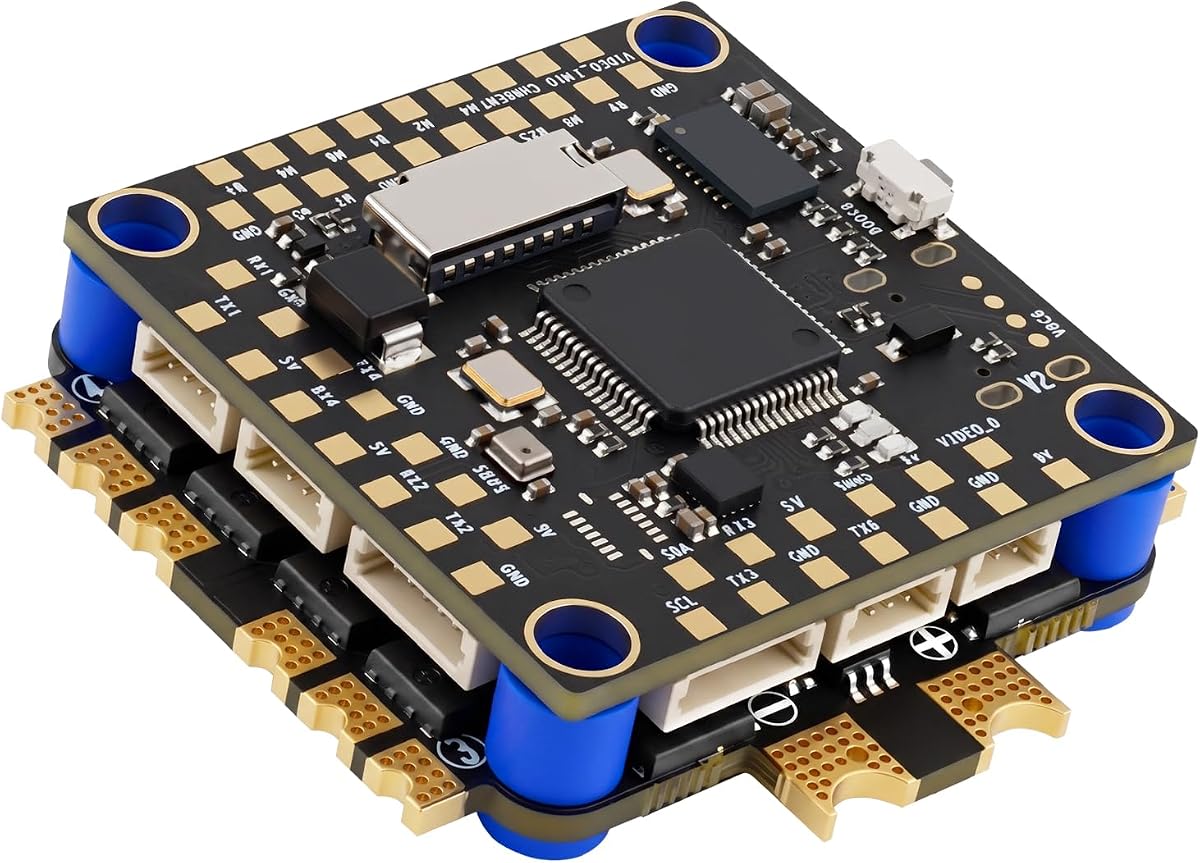
This H743 stack features a high-performance STM32H743 processor and a 60A 32-bit ESC. It is designed for FPV and racing drones, offering comprehensive connectivity with CAN bus and OSD support.
We may earn a commission when you buy through this link, at no additional cost to you.
The stack supports 2-8S LiPo batteries and includes dual IMUs for enhanced stability. Its compatibility with Betaflight, INAV, PX4, and Ardupilot ensures versatile firmware options.
While the ESC is powerful, this stack is primarily marketed for racing builds. Buyers planning complex VTOL flights should verify if the firmware supports their transition modes.
This controller is ideal for high-speed FPV builds needing robust power and connectivity. If you prioritize performance and future-proofing with CAN bus, this stack is a strong candidate.
Offers a reliable combination for lightweight builds with a continuous 60A per channel and burst current over 80A for responsive motor control.
Compatible with Betaflight, PX4, INAV, and Ardupilot, ensuring quick configuration options and ease of setup for both beginners and professionals.
We may earn a commission when you buy through this link, at no additional cost to you.
This H743 stack pairs the powerful STM32H743 processor with a 50A 8-bit ESC. It is designed for lightweight builds and supports 2-6S LiPo batteries for efficient flight.
We may earn a commission when you buy through this link, at no additional cost to you.
Its compact design simplifies installation and enhances assembly efficiency with a total weight of 21.5g. The stack offers high-frequency PWM and DSHOT protocols for precise throttle response.
While versatile, the 50A ESC may not handle high current bursts as well as higher rated options. This makes it suitable for smaller or moderate performance VTOL builds.
This controller is best for pilots needing a reliable, compact stack for standard builds. If weight savings are a priority and 50A is sufficient, this stack offers great value.
With a total weight of 21.5g for both ESC and controller, the stack simplifies installation and enhances assembly efficiency for space constrained builds.
We may earn a commission when you buy through this link, at no additional cost to you.
The Pixhawk 6C features a powerful STM32H743 processor and dual redundant IMUs for unmatched reliability. It is pre-installed with PX4 Autopilot and includes vibration isolation to reduce sensor noise.
We may earn a commission when you buy through this link, at no additional cost to you.
Its low-profile form factor makes it versatile for academic research and commercial applications. The integrated heating resistors ensure sensors work at optimum temperature for consistent readings.
While highly advanced, it comes at a premium price. The plastic case is ultra-light but less durable than aluminum options for harsh environments.
This controller is best for developers needing high computational power and redundancy. If you require precise autonomous vehicle algorithms, this unit provides the necessary hardware foundation.
Features high-performance, low-noise redundant IMUs from Bosch and InvenSense, providing unmatched reliability for critical flight algorithms.
Effectively filters out high-frequency drone vibration and reduces sensor noise to guarantee precise readings and better overall flight performance.
We may earn a commission when you buy through this link, at no additional cost to you.
The AERO SELFIE F405NC stack offers O3 O4 AIR interface compatibility, making it ideal for modern FPV video systems. It features a dual IMU setup with high performance sensors.
We may earn a commission when you buy through this link, at no additional cost to you.
With a 60A ESC and support for 2-6S LiPo batteries, it balances power and weight. The stack includes comprehensive connectivity with UART ports and OSD support.
While powerful, buyers should ensure their video system matches the O3 O4 interface requirements. The rating of 4.4 suggests high satisfaction among users who need modern video integration.
This controller is best for pilots upgrading to O3 O4 video systems while keeping a reliable stack. If compatibility with latest camera interfaces is key, this unit is a strong choice.
Compatible with O3 O4 AIR interface, ensuring seamless integration with modern FPV video systems for high-quality live feeds.
We may earn a commission when you buy through this link, at no additional cost to you.
This H743 stack delivers a high-performance STM32H743 processor and 60A 32-bit ESC in a compact package. It supports 2-6S LiPo batteries and includes dual IMUs for stability.
We may earn a commission when you buy through this link, at no additional cost to you.
Compatible with Betaflight, PX4, INAV, and Ardupilot, it offers versatile firmware options. The stack provides comprehensive connectivity with 7 UART ports and OSD support.
The user rating of 3.7 indicates mixed feedback which may reflect setup complexity or hardware variability. Buyers should verify current reviews for quality consistency before purchase.
This controller is best for users seeking H7 performance on a budget. If you need advanced processing and a robust ESC, this stack offers solid technical specs.
Offers 480MHz processing power ensuring efficient handling of complex flight algorithms and high frequency telemetry updates.
We may earn a commission when you buy through this link, at no additional cost to you.
Choosing the right flight controller for VTOL builds requires balancing power, firmware, and physical size. This guide covers key factors to help you select the best unit for your needs.
Flight controllers rely on the processor to calculate flight dynamics. Modern STM32H7 processors offer high speeds for autonomous VTOL transitions. Faster processing reduces latency and improves stability.
Prioritize processors like STM32H743 for complex builds needing precise calculations during flight mode changes.
Open source firmware like ArduPilot or PX4 is essential for VTOL builds. These support complex flight logic and fail-safe systems. Proprietary firmware may limit customization options.
Ensure the controller supports ArduPilot or PX4 if you need autonomous flight capabilities.
Dual IMUs provide backup in case one sensor fails. This is critical for safety in autonomous flights. Look for controllers with redundant compasses and barometers.
Redundant sensors reduce risk of catastrophic failure during flight.
VTOL builds often use high voltage batteries. Ensure the controller supports 2-12S power rails. Incorrect voltage handling can damage electronics.
Verify the voltage support to match your battery configuration.
Compact stacks save weight but limit expansion. Full size controllers allow more ports for peripherals. Consider your frame's space constraints.
Match the controller size to your drone frame requirements.
Vibration affects sensor readings. Controllers with built-in isolation or mounts improve accuracy. This is vital for VTOL transition stability.
Look for vibration isolation to ensure reliable sensor data.
Sufficient UART ports are needed for GPS, telemetry, and cameras. CAN bus support is becoming standard for expansion. Check port counts before buying.
Ensure enough ports for all your planned peripherals.
Active communities provide guides and firmware updates. Open source controllers often have larger support networks. This helps resolve issues quickly.
Choose controllers with active forums and documentation.
Before installing, secure the controller with vibration dampening mounts to prevent noise interference. Use anti-vibration rubber grommets to isolate sensors from motor vibrations.
Update firmware using the recommended software tools before initial flight. Calibrate sensors to the specific orientation of your drone to ensure accurate readings.
Store the controller in a dry, cool place when not in use. Avoid exposing it to excessive heat or humidity to prevent corrosion or component damage.
The Pixhawk 2.4.8 PX4 is ideal for DIY VTOL builds because it supports open source firmware and includes GPS. It provides the necessary flexibility and reliability for complex transitions.
Not all controllers support ArduPilot. Most high-end open source units do, but proprietary boards may have limited support. Always check compatibility before buying.
Dual IMUs provide redundancy in case one sensor fails. This ensures continuous accurate data which is critical during transition phases of VTOL flight.
Racing controllers usually lack VTOL specific logic. You may need to modify firmware or use specialized stacks. It is safer to use controllers explicitly designed for fixed wing or VTOL.
Connect the GPS to a UART port designated for telemetry. Follow the wiring diagram in the controller's manual. Ensure the baud rate matches the configuration settings.
VTOL controllers should support your battery's voltage range. Most modern units handle 2-12S. Verify the power input limits to prevent damage.
Yes, vibration isolation is necessary. It reduces noise on sensors during motor operation. This improves stability during VTOL transitions.
Update firmware regularly to access new features and security fixes. Check the manufacturer's website for release notes. Back up your settings before updating.
Choosing the right flight controller depends on your project needs. The Pixhawk 2.4.8 PX4 offers the best balance of open-source support and GPS integration for hybrid builds.
For premium users needing redundancy, the Pixhawk 6C delivers unmatched reliability with dual IMUs. Budget builders may prefer the F405 Wing for its APP control simplicity.
Always check current prices and availability before purchasing. Specifications may change with newer models. Select the controller that best matches your build complexity.