
Gas Test Pressure Gauge 60 Pound
4.3Editor score
Forged steel bell shape body
Durable glass lens non fading
3/4 FNPT connection standard
This guide compares the top gas line pressure gauge options for safety and accuracy, helping you choose the right tool for testing natural gas and propane
Ensuring safe gas line operations requires precise pressure measurement tools. A reliable gas line pressure gauge helps homeowners and professionals detect leaks and maintain optimal system performance without compromising safety standards or risking hazardous exposures during routine maintenance tasks.
We evaluated ten top-rated models based on durability, accuracy, connection types, and ease of use. Our comparison includes budget-friendly testers and professional-grade kits designed for natural gas and propane applications. Each product was assessed for build quality, readability, and compatibility with standard household gas lines.
Each pick highlights specific strengths like corrosion resistance or dual-scale readings. While prices may fluctuate over time, these models represent strong value for their intended uses. Always verify current availability and consult local codes before installing or testing any gas line components in your property.
4.3Editor score
4.5Editor score

4.7Editor score
This side-by-side comparison outlines key specifications for each model to help you identify the right fit for your specific gas testing needs and budget constraints.


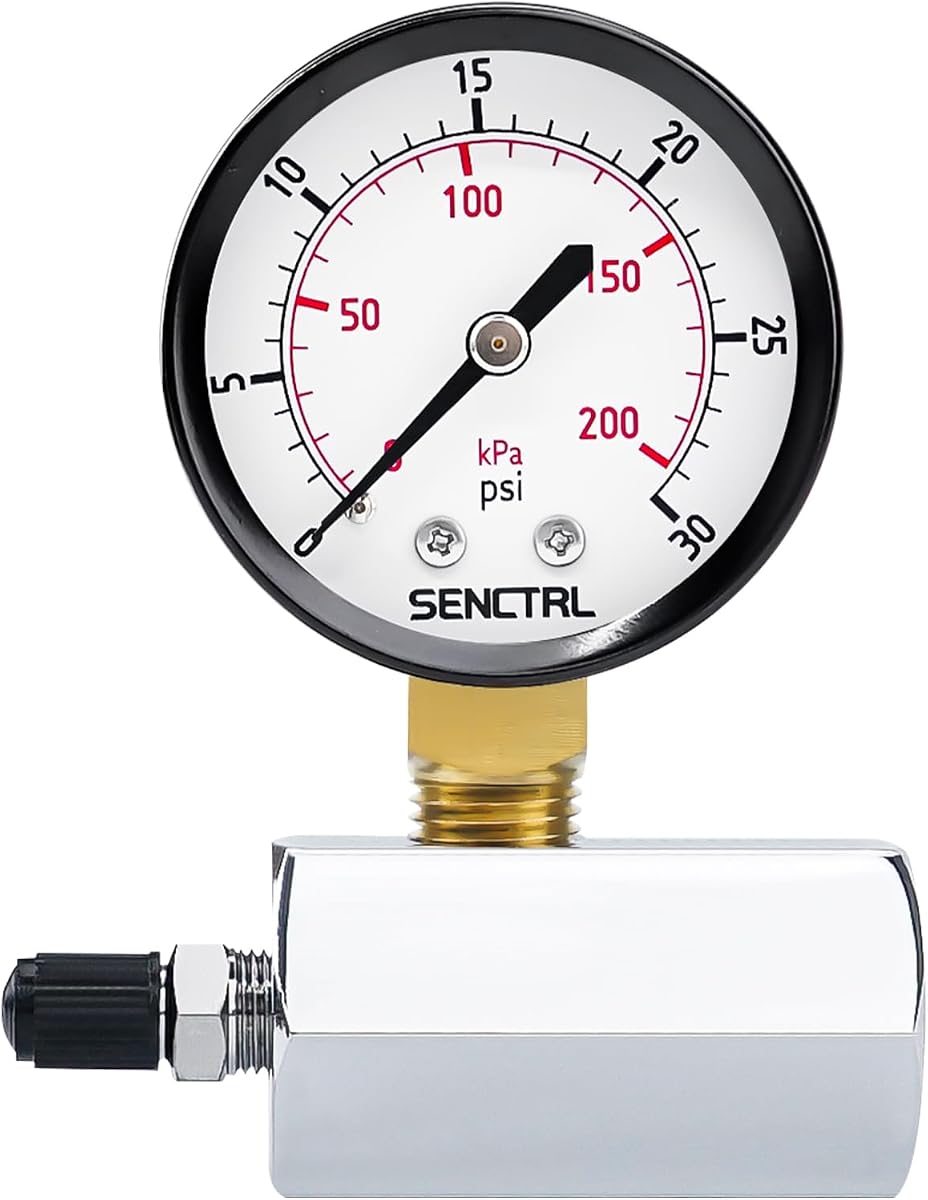
The SENCTRL 0-30 Psi Gas Pressure Test Gauge stands out as a reliable choice for homeowners checking natural gas lines. With a 4.5 star rating it delivers accurate readings across its range. The assembly includes a valve body that attaches directly to gas lines for streamlined testing without extra tools.
We may earn a commission when you buy through this link, at no additional cost to you.
Its construction features a chrome plated steel body that resists corrosion over time. The 2 inch dial provides clear visibility of pressure levels with dual scale markings for both PSI and kPa users. The black steel case protects the internal components from damage during storage or transport in tool kits.
While the 30 PSI limit covers most residential needs it may not suit higher pressure industrial applications. Users should ensure proper tape sealing on threads to avoid leaks during testing. These trade-offs are acceptable for standard household gas system diagnostics and maintenance tasks.
This gauge is ideal for DIYers and technicians needing a straightforward gas testing tool. Its balance of durability and readability makes it a top recommendation. Install it securely and follow safety protocols when testing gas lines in any environment.
The 3/4 FNPT female connection allows quick attachment to gas lines without adapters saving time during setup.
Chrome plating on the steel body ensures long term resistance against moisture and corrosion common in utility spaces.
We may earn a commission when you buy through this link, at no additional cost to you.
The Uharbour 30psi Brass Gas Line Pressure Tester offers robust construction for natural gas testing. It earns a 4.3 star rating for its durability and clarity. The forged brass cup-shaped design resists corrosion extending the life of the device in indoor or underground gas line scenarios.
We may earn a commission when you buy through this link, at no additional cost to you.
Its 2 inch transparent steel gauge improves reliability and integrity during pressure checks. The dual scale bar and PSI allows easy reading for different users. Connection is straightforward with 3/4 NPT female inlet and 1/4 NPT tank valve for versatile testing options.
Users must wrap PTFE tape and tighten all parts to avoid leakage during use. This adds a step but ensures safety. The cost reflects the quality materials used which may be higher than basic plastic alternatives found on the market.
This tester suits those prioritizing long term durability over lowest cost. It works well for gas and air pressure checks in tubes. Install carefully and verify seals before relying on readings for critical maintenance or inspection tasks.
Forged brass ensures the measuring device withstands harsh conditions without degrading over extended periods of use.
Suitable for gases that do not obstruct ports or corrode copper alloy making it flexible for multiple applications.
We may earn a commission when you buy through this link, at no additional cost to you.
The Gas Test Pressure Gauge 60 Pound delivers solid performance at an entry level price. With a 4.3 star rating it provides reliable readings up to 60 PSI. The forged steel bell shape body adds strength without significantly increasing cost for budget conscious buyers.
We may earn a commission when you buy through this link, at no additional cost to you.
Its 2 inch pressure gauge features a durable glass lens that does not fade over time. The brass valve and steel case protect internal components during use. Dual scale markings allow flexible interpretation for users familiar with kPa or PSI standards.
It lacks a protective case which means careful storage is needed to prevent damage. The valve material is basic but functional for most residential needs. These limitations are acceptable given the low cost and higher range compared to standard 30 PSI units.
This gauge is perfect for occasional testers needing a broader range. It handles standard gas lines well without breaking the bank. Store it safely and ensure proper connections to get accurate results during your gas system checks.
The 60 PSI capacity covers more scenarios than typical 30 PSI gauges while maintaining a budget friendly price point.
Non fading glass ensures the dial remains readable even after prolonged exposure to light and regular use.
We may earn a commission when you buy through this link, at no additional cost to you.
The MEASUREMAN 2 Brass Gas Pressure Test Gauge Assembly offers a practical solution for gas line testing. Rated 4.3 stars it features a 2-1/2 inch dial for easy reading. The brass body and direct adapter attach easily to standard gas lines for quick setup.
We may earn a commission when you buy through this link, at no additional cost to you.
Its dry construction with brass wetted parts protects internal mechanisms. The black steel case adds durability against drops and bumps. The +/-3-2-3% accuracy is standard for this category ensuring reasonably precise readings for maintenance purposes.
While dry design avoids moisture issues it may not suit liquid applications. Accuracy varies slightly across the range which is normal for analog gauges. These factors are manageable for typical gas pressure checks in residential or light commercial settings.
This assembly is great for users needing a larger dial view. It balances cost and functionality well for regular testing. Ensure threads are sealed properly to maintain safety and accuracy during every use cycle.
The 2-1/2 inch dial offers larger numerals making it easier to read from a distance or in low light.
Dry construction with brass wetted parts prevents corrosion from moisture extending the gauge operational lifespan.
We may earn a commission when you buy through this link, at no additional cost to you.
The BETOOLL Fuel Pressure Test Kit provides a broader range for fuel system diagnostics. With a 4.4 star rating it reads up to 100 PSI. Three adapters allow compatibility with various fuel line sizes making it versatile for engine checks beyond standard gas lines.
We may earn a commission when you buy through this link, at no additional cost to you.
High quality brass connectors and corrosion resistant rubber hose ensure durability. It helps identify low pressure faulty regulators or leaking injectors. The universal design fits any engine needing fuel pressure readings for efficient troubleshooting.
It should never be used on diesel engines which require different specifications. This limits its scope to gasoline systems. These constraints are clear in the product notes ensuring users avoid misuse and maintain safety standards during testing.
This kit suits automotive enthusiasts and mechanics working on fuel systems. Its adaptability and range make it a useful tool for diagnostics. Follow the instructions carefully and respect the diesel engine limitation for safe operation.
Universal design allows use on any engine needing fuel PSI readings simplifying one tools needed for diagnostics.
Helps identify issues like low pressure faulty regulators or clogged filters quickly without complex equipment.
We may earn a commission when you buy through this link, at no additional cost to you.
The MEASUREMAN Natural Gas or LP Gas Manifold Pressure Test Kit is specialized for appliance manifolds. Rated 4.5 stars it measures 0-35 water column which is standard for gas appliances. The 40 inch hose allows flexible testing at a distance from the source.
We may earn a commission when you buy through this link, at no additional cost to you.
It features a beryllium diaphragm capsule for reliable low pressure sensing. The brass movement and connection add durability. A molded plastic box protects the gauge and hose for safe transport and storage in utility areas.
This kit focuses on water column units not PSI for high pressure. It may not suit general gas line testing beyond appliances. These limitations are appropriate for its designed use case ensuring accurate measurements for stoves or heaters.
Ideal for technicians servicing gas appliances this kit offers precision. The hose length simplifies access to tight spots. Use it as intended to maintain safety and get reliable readings during installation or maintenance tasks.
Designed for measuring low pressure across appliance manifolds ensures accuracy for stoves heaters and other gas devices.
The 40 inch rubber hose allows convenient access to manifold connections without straining the connection points.
We may earn a commission when you buy through this link, at no additional cost to you.
The DANCO Gas Test Gauge offers precise readings with 1/10 increments up to 15 psi. Rated 4.2 stars it uses a chrome plated body for safety. The clear facing helps see measurements easily during tank pressure checks in propane systems.
We may earn a commission when you buy through this link, at no additional cost to you.
Its plastic face resists breaking while the steel case ensures sturdiness. The 3/4 inch MPT thread fits standard tank connections for secure attachment. This design is intended specifically for gauging gas pressure in tanks rather than general line testing.
The 15 PSI limit restricts use to low pressure tank applications. It may not work for household gas line diagnostics requiring higher ranges. These limits are acceptable for its intended purpose ensuring safe tank monitoring without overextension.
This gauge is best for propane tank owners needing precise low range checks. Its readability and durability are strong points. Install on compatible threads and use only for tank pressure to avoid inaccurate or unsafe readings.
The 1/10 increments allow detailed monitoring of pressure changes in tanks for precise safety checks.
Designed to fit onto 3/4 inch MPT threads ensures secure connection on standard propane gas tanks.
We may earn a commission when you buy through this link, at no additional cost to you.
The MEANLIN MEASURE Manifold Gas Pressure Test Kit earns the highest 4.7 rating for professional use. It measures 0-35 WC with a 40 inch hose for flexible access. The zero adjustable setting adds precision for calibrating readings during gas testing.
We may earn a commission when you buy through this link, at no additional cost to you.
It includes multiple hex bushings for solid connections across different gas systems. The barbed connector ensures flexibility for various places. Temperature range from 32 to 131 F supports use in diverse environments without performance loss.
The higher price reflects its advanced features and robust connections. Water column units are specific to appliance manifolds not all gas lines. These constraints are typical for professional kits ensuring accurate data when precision matters most in testing.
This kit is ideal for technicians needing advanced features. Its adjustability and connection options save time on site. Use the proper bushings to ensure solid connections and reliable results during professional inspections.
Zero adjustable setting allows precise calibration for accurate pressure readings across different testing scenarios.
Multiple hex bushings and barbed connectors ensure flexible secure connections to various gas system configurations.
We may earn a commission when you buy through this link, at no additional cost to you.
The Boltigen Fuel Pressure Gauge offers stable readings with glycerin filled design. Rated 4.4 stars it reads 0-15 PSI for fuel systems. The center back mount provides accessibility and visibility for monitoring pressure during operation in vehicles.
We may earn a commission when you buy through this link, at no additional cost to you.
It includes 3/8 and 5/16 inch brass barb fittings for various fuel line sizes. High quality stainless steel and brass materials ensure durability and corrosion resistance. Clamps make installation convenient and hassle-free for quick setup on lines.
The low range suits fuel pressure regulators not general gas lines. Inline installation requires access to the fuel line for setup. These are standard for automotive fuel diagnostics making it suitable for car marine and industrial fuel applications.
This gauge is great for automotive tuning and diagnosis. Its stability and visibility help fine-tune performance. Install securely on compatible lines to get consistent accurate readings during engine operation.
Glycerin filled design reduces needle vibration providing accurate stable readings during fuel system checks.
Center back mount installation offers accessibility and visibility making it convenient to monitor while operating.
We may earn a commission when you buy through this link, at no additional cost to you.
The OTC 5630 Fuel Pressure Test Kit delivers professional grade performance with a 4.5 rating. It locates malfunctions like fuel filters or pumps without removing components. The large easy to read gauge features impact resistant housing for reliability in shops.
We may earn a commission when you buy through this link, at no additional cost to you.
High quality solid brass fittings and tubing ensure long lasting performance. A convenient pressure relief valve allows for safe clean testing during maintenance. The range covers 0-100 PSI making it versatile for many automotive fuel system checks.
Its professional cost may be higher than DIY kits. It is tailored for vehicle fuel systems not general gas lines. These trade-offs are acceptable for technicians needing safety and durability in demanding environments.
This kit is ideal for automotive professionals needing reliability. Its safety features and ease of use speed up diagnostics. Ensure proper installation and use the relief valve for safe testing procedures.
A convenient pressure relief valve allows for safe clean testing reducing risk during maintenance procedures.
Impact resistant rubber encased housing protects the gauge from damage in workshop environments.
We may earn a commission when you buy through this link, at no additional cost to you.
Selecting the right gas line pressure gauge depends on your application needs and environmental conditions. Here are key factors to consider before purchasing.
Ensure the gauge range matches the expected pressure of your gas line. Residential lines often operate at 30 PSI or lower while propane tanks may differ. Using a gauge with too low a range can lead to inaccurate readings or damage.
Choose a model with a range that exceeds your needs slightly to allow for safe margins during testing.
Check the thread size and type such as 3/4 FNPT or 1/8 NPT to match your gas line fittings. Proper connections prevent leaks that could be dangerous during pressure tests.
Look for adapters if your line differs from the gauge standard to ensure secure fit.
Forged brass or steel bodies resist corrosion better than plastic in humid or outdoor environments. Brass wetted parts prevent reactions with gas components over time.
Invest in metal constructions for long term reliability especially in utility spaces.
Larger dials like 2 inch or more improve visibility when checking pressure. Dual scale options for PSI and kPa cater to different preferences.
Clear markings and anti-glare finishes help avoid errors in low light conditions.
Most gauges offer +/-3-2-3% accuracy which is standard for residential use. Professional kits may have tighter tolerances for critical measurements.
Verify the accuracy rating suits your testing requirements for safety compliance.
Extended hoses like 40 inches allow testing away from the connection point. This is useful for hard to reach appliances or manifolds.
Ensure hoses are flexible and resistant to kinks for smooth flow during testing.
Features like pressure relief valves or beryllium diaphragms add protection during use. These prevent over pressurization and damage.
Prioritize models with safety elements if you work in high pressure environments.
Budget options may lack features like zero adjustment or long hoses. Higher cost models often offer better durability and precision.
Balance your budget with the frequency of use to find the best value.
First shut off the gas supply to the line before attaching the gauge. Wrap PTFE tape around the threads to ensure a tight seal and prevent leaks during testing.
Attach the gauge securely to the gas line port and turn on the supply slowly. Monitor the needle for stable readings and check for any drops indicating a leak.
After testing turn off the gas and relieve pressure before removing the gauge. Store in a protective case and clean the brass components to prevent corrosion over time.
Most residential natural gas lines operate between 5 to 7 inches of water column which is about 0.3 PSI. Propane systems may use up to 11 inches of water column. Gauges with 0-30 PSI cover these ranges easily for safety checks.
Yes but check the connection types as propane often uses different fittings. Ensure the gauge materials are compatible with both gas types to avoid corrosion. Adjust the pressure settings according to the gas type requirements.
Test after installing new appliances or whenever you smell gas or notice performance issues. Annual checks are recommended for older systems to ensure safety. Always follow local codes for inspection frequency.
PSI measures pounds per square inch while water column measures pressure in inches of water. 1 PSI equals about 27.7 inches of water column. Gas appliances often use water column for low pressure readings.
Fluctuations may indicate a leak unstable supply or air in the lines. Check all connections for tightness and ensure the gas supply is steady. If issues persist consult a professional for further diagnostics.
Analog gauges are simpler and require no battery making them reliable for basic tests. Digital units offer precise readings but need power. Choose based on your environment and preference for stability.
Homeowners can often check pressure with basic gauges but complex repairs require licensed professionals. Check local regulations before testing. Safety always comes first when dealing with gas lines and appliances.
Zero pressure suggests a shut valve leak or gauge failure. Verify gas supply is on and connections are tight. If the gauge itself is faulty replace it before testing to avoid unsafe conditions.
We reviewed ten top gas line pressure gauges from budget picks to professional kits. The SENCTRL 0-30 Psi stands out as our Editor's Choice for its balance of durability and readability.
Consider your specific gas line needs and connection types when selecting a model. Features like extended hoses or adjustable settings add value for frequent testers.
Prices may change so check current offers before purchasing. Always prioritize safety and proper installation when testing gas systems to protect your property.